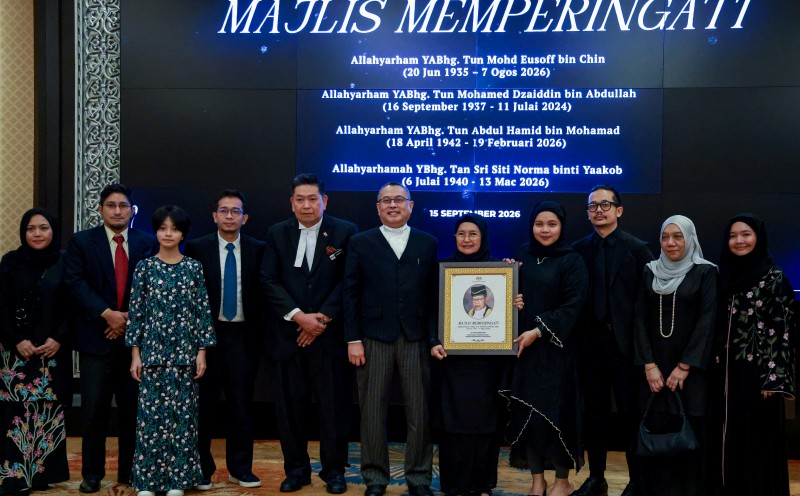
From barefoot schoolboy to chief justice: Remembering Eusoff Chin
PUTRAJAYA: He walked barefoot to school, sold his mother’s kuih at a railway station during the Japanese occupation and studied beneath streetlights because there was no proper light at home.
In the small town of Kampar, young Eusoff Chin walked barefoot to school, supplementing his family's modest income by selling his mother's kuih from a railway station during the Japanese occupation. Despite limited resources and studying beneath streetlights due to lack of proper lighting at home, Eusoff excelled academically, topping the Senior Cambridge Examination.
His promising start came to a sudden halt upon his father's death, as the family could no longer afford his education after three months at Anderson School in Ipoh. However, a change of fortune awaited when Eusoff became a probationary teacher in Kelantan in 1955. His potential was recognized by a senior teacher, who encouraged him to aim higher in life—an intervention that proved pivotal.
The following year, Eusoff joined the public service as a Labour Officer and later the Kelantan Civil Service as an assistant district officer, where he also presided as a lay magistrate. His talents caught the attention of then Supreme Court registrar Tan Sri S. S. Gill, who recommended his scholarship to then Chief Justice Sir James Thompson.
Eusoff pursued his legal studies at Lincoln's Inn, becoming a barrister in 1963. Over the ensuing decades, he held various legal and judicial roles, ultimately being elevated to the High Court bench in 1982 and appointed as the second Chief Justice of Malaysia on September 25, 1994. Despite a career filled with judicial and public service achievements, Eusoff's daughter Zuliana recalls a gentle father figure who never allowed his stature to define him.
He enjoyed simple pleasures like fishing, mamak breakfasts, reading books, and playing music, fostering a nurturing environment that allowed his children to pursue their own passions. Zuliana emphasizes that her father's legacy transcended his judicial accomplishments, as he remained their father, unchanging in his values and love.
Written by urgent.news from New Straits Times's reporting — not their text. Machine-written — may contain errors; check the original before relying on it.