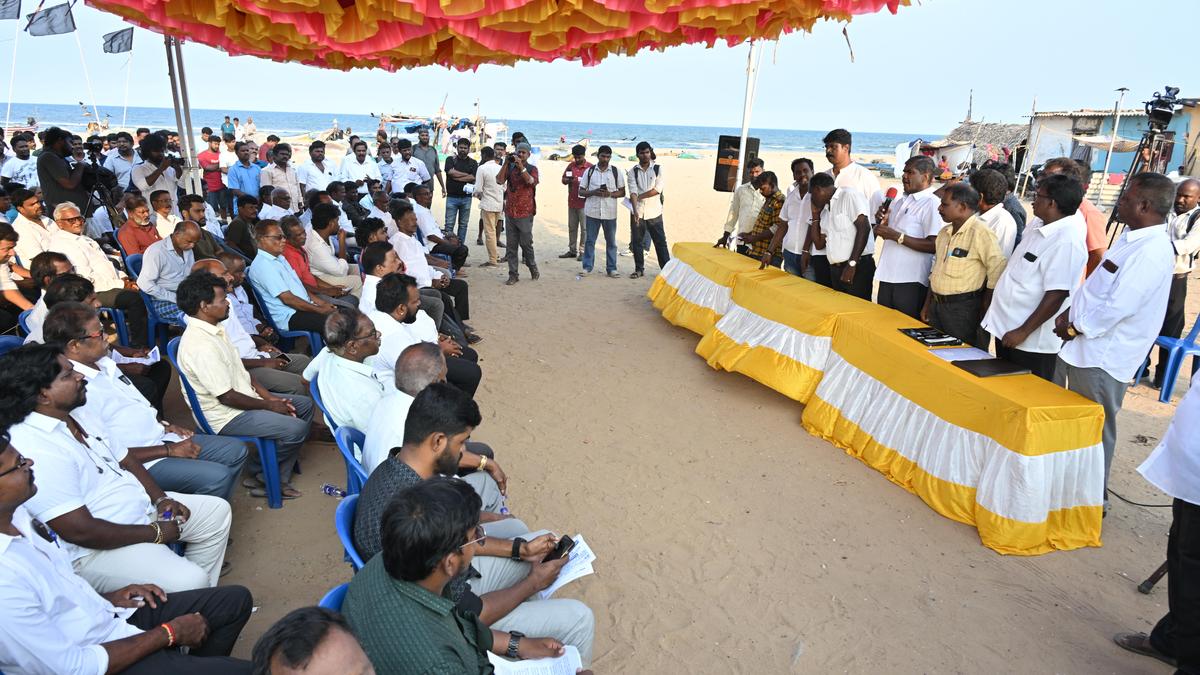
Fishermen urge Tamil Nadu government to drop the plan to build the Secretariat at Foreshore Estate
The Tamil Nadu Power Distribution Corporation Limited (TNPDCL) continues to heavily depend on financial aid from the Tamil Nadu government, as revealed by the State Finances Audit Report for Tamil Nadu by the Comptroller and Auditor-General of India (CAG). Over the past 14 years, primarily from 2013-14, the government's assistance in the form of tariff subsidies and grants has amounted to ₹2.55 lakh crore.
Comparing the final figures for 2024-25 with those for 2013-14, the growth in financial support has been a staggering 451%, with only the revised estimates for 2025-26 and 2026-27 available. On average, the annual assistance provided is around ₹18,130 crore.
Since 2021-22, the State government has been obliged to fully absorb the power discom's losses, leading to a precarious financial situation. Data shows that the combined figure of tariff subsidies and grants surpassed the five-digit mark in 2016-17 when the scheme to provide free electricity up to 100 units to domestic consumers was introduced.
Five years later, in 2020, the discom received a sanctioned assistance of approximately ₹30,230 crore under the Central government's COVID-19 liquidity infusion scheme. As the disparity between the average cost of supply and average revenue realized has narrowed down, thanks to government's generous assistance, and a positive outcome seems likely this year, TNPDCL may receive fewer grants as it has in these five years.
However, ₹5,000 crore has been set aside for grants in the current year, along with tariff subsidies.
About ₹18,860 crore of the subsidy figure this year is allocated for domestic consumers, who are given free electricity of up to 200 units, provided their overall consumption does not exceed 500 units bi-monthly. This, coupled with the Supreme Court's recent directive requiring the government to recover regulatory assets, which are similar to deferred income, demands the government to allocate ₹11,800 crore per year for five years (2026-27 to 2030-31), totaling ₹59,000 crore, towards the power discom.
Alternatively, this sum can be recovered through enhanced consumption charges, as the regulatory assets cover the previously incurred losses that can be recovered from consumers in the future, depending on the regulatory body's approval. However, the Tamilaga Vettri Kazhagam-led government has stated that there will be no upward power tariff revision, leaving the State government to bear the additional burden.
Written by urgent.news from The Hindu's reporting — not their text. Machine-written — may contain errors; check the original before relying on it.
This story
This is one outlet's version. Read the fullest account.