Curiosity rover spots odd 'footprints' on Mars | Space photo of the day for Sept. 15, 2026
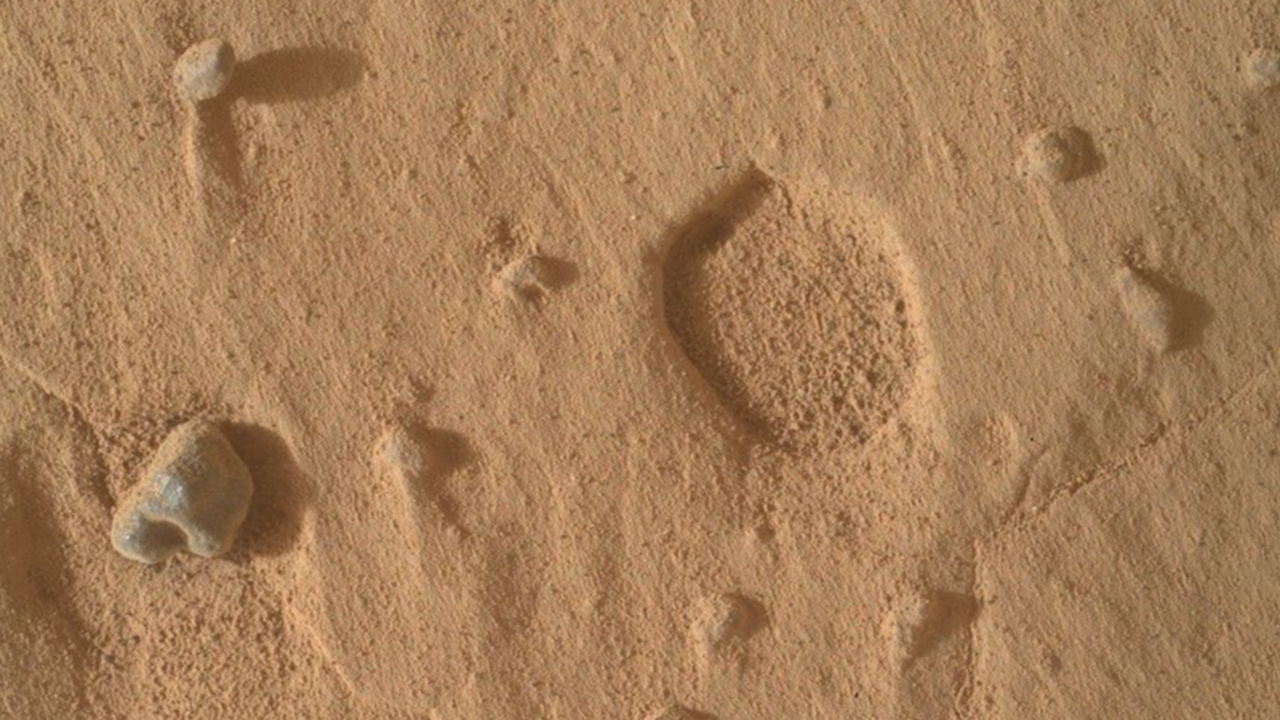
A peculiar feature resembling a footprint has emerged on Mars, baffling scientists who have never encountered anything like it before. Although the image may evoke thoughts of a Martian mystery, it turns out to be a unique geological formation discovered by NASA's Curiosity rover.
Curiosity, an enduring member of NASA's Red Planet explorers, continues to intrigue with its discoveries on Mars 14 years after its landing. Recently, the rover spotted peculiar features on the slopes of Mount Sharp that have left researchers astounded. Michelle Minitti, deputy principal investigator for Curiosity's Mars Hand Lens Imager (MAHLI), expressed her astonishment, stating that these features are unlike anything they've observed previously on the Red Planet.
The peculiar pits, scattered across the Martian bedrock, are notably broad and shallow, contrasting with the usual small divots found on Mars. Unlike past features that often come with obvious objects once contained within, these new pits lack such indicators. The team employed various instruments, like MAHLI, Mastcam camera, ChemCam, and APX (Alpha Particle X-Ray Spectrometer), to gather comprehensive data on the unusual pits.
While the team has identified interesting layers in the pit material that exhibit chemically distinct properties from the surrounding bedrock, the mystery deepens as they await more insights into the origins, age, and significance of these unusual formations.
Written by urgent.news from Space.com's reporting — not their text. Machine-written — may contain errors; check the original before relying on it.