Communities pay for gas expansion
More than 200 community representatives from eastern Thailand, joined by Greenpeace activists, protested outside Gastech 2026 in Bangkok yesterday, September 14, warning that new gas investment could lock Thailand into fossil fuel dependence for decades. Campaigners from Greenpeace Thailand and communities in Chachoengsao, Prachin Buri and Rayong gathered outside BITEC Bangna as Prime Minister…
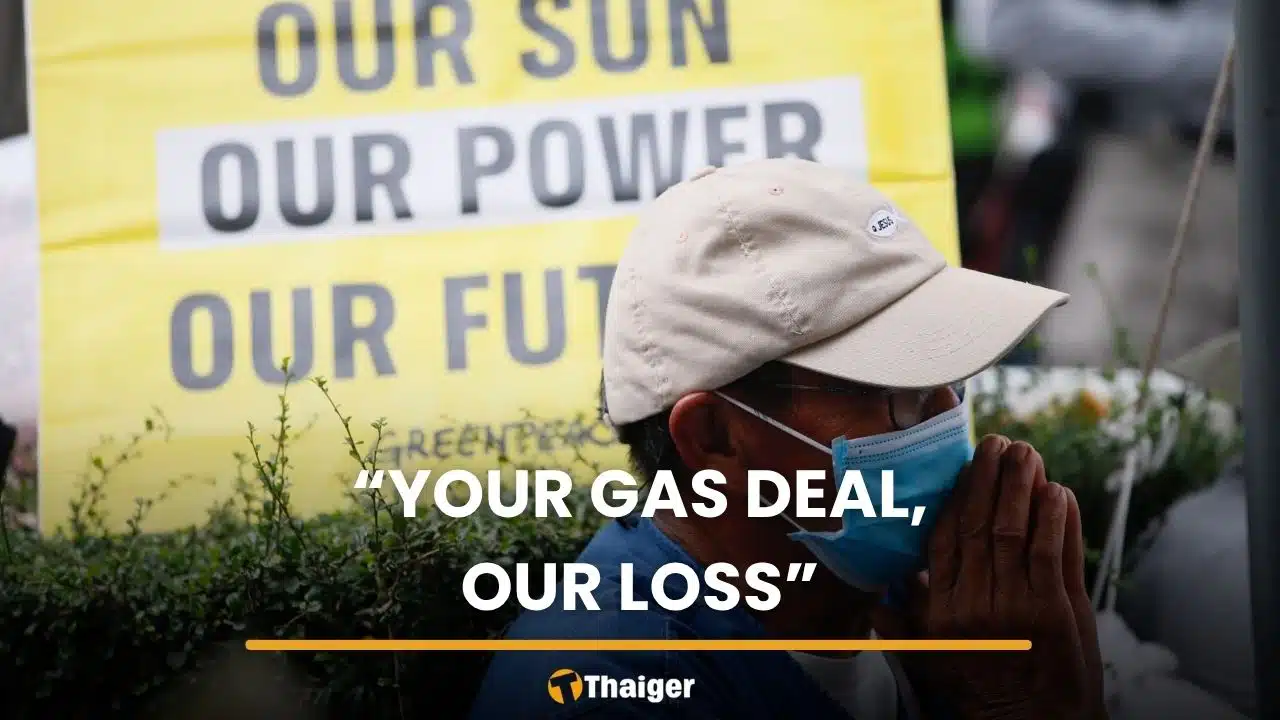
Over 200 community representatives from eastern Thailand, accompanied by Greenpeace activists, staged a protest outside the Gastech 2026 energy conference in Bangkok on September 14. The protestors, including those from Greenpeace Thailand and local communities in Chachoengsao, Prachin Buri, and Rayong, warned that new gas investments could lock Thailand into fossil fuel dependence for decades.
They displayed a large banner demanding the government prioritize renewable energy over further fossil gas and LNG expansion. Some protesters even entered the conference venue carrying an open letter intended for Prime Minister Anutin Charnvirakul, who later left without publicly responding to their concerns.
Gastech 2026, held from September 14 to 17, is a four-day energy conference hosted by Thailand’s Ministry of Energy, attracting more than 50,000 energy professionals from over 150 countries. Co-hosted by major energy companies such as Shell, Chevron, and ExxonMobil, the event focuses on discussions about LNG, natural gas, power generation, hydrogen, and the wider energy transition.
However, Greenpeace and community networks argue that new LNG terminals and gas-fired power plants could leave Thailand dependent on fossil gas for decades, exposing the country to volatile international prices and supply disruptions.
The protesters assert that communities in Rayong, Chachoengsao, and Prachin Buri are already facing cumulative pollution, pressure on natural resources, and impacts on their livelihoods from ongoing industrial and energy development projects. They cite Map Ta Phut as an example, highlighting the project's 35-year private concession and the associated environmental and health concerns.
While the government maintains that gas is essential for maintaining a reliable electricity supply and supporting Thailand's energy transition, the protestors argue that long-lived gas projects could keep the country tied to fossil fuels for decades. They call for stronger environmental assessments, increased public participation, and greater investment in renewable energy sources, electricity storage, and grid upgrades.
Written by urgent.news from The Thaiger's reporting — not their text. Machine-written — may contain errors; check the original before relying on it.