Bundesregierung: „Die schwerste Krise der Partei seit ihrer Gründung“: Tag der Entscheidung für Merz rückt näher
Die Landeschefs der CDU beraten im Stillen über die Zukunft der Partei. Es geht um den Parteivorsitz – und das Kanzleramt. Drei Namen kursieren bereits. Merz aber kämpft.
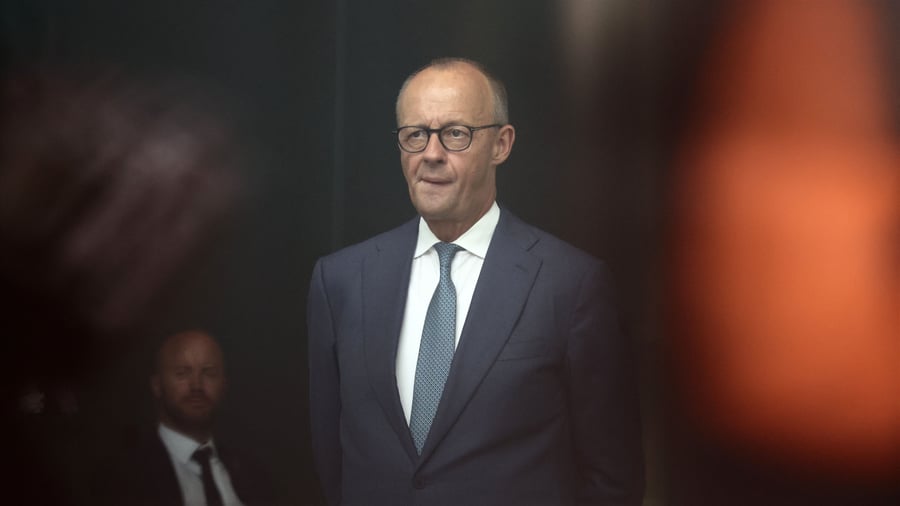
On Sunday, the showdown will take place at the Konrad-Adenauer-Haus, the CDU headquarters, with Generalsekretärin Franziska Hoppermann inviting the members of the party's Presidium to Berlin at 5 pm. This meeting, common on election days, appears to be more significant than mere elections in Berlin and Mecklenburg-Vorpommern. The political future of party chief Friedrich Merz and possibly his chancellorship could be at stake.
Written invitations to the Presidium are said to be sent, with no one from the leadership to speak casually about the meeting. The agenda includes Merz's report, Hoppermann's report, and "miscellaneous". Merz is said to be fighting for his power, urging the leadership members of the CDU to swear to him: support him or demand his resignation?
The Mecklenburg-Vorpommern state election is seen as decisive. If the CDU, as predicted by polls, receives only seven percent of the votes and performs as poorly as never in the history of the Federal Republic, the party might even withdraw from the Schleswig-Holstein Landtag and find itself in the opposition outside the parliament for the first time since 1945.
Merz might not be able to stand this scenario, according to reports. Even if the CDU manages to stay in the Landtag and becomes the strongest force in Berlin, it might not be enough for Merz. Many have grown to believe: "This is the end." The chancellor has not been able to explain what his plan is or where the party should follow him next.
Merz's response of difficult conditions is no longer enough. For days, the party leaders have been on the phone, and they are coming to the conclusion that the situation is untenable. The ministers of state Hendrik Wüst (North Rhine-Westphalia), Boris Rhein (Hesse), and Daniel Günther (Schleswig-Holstein) are close to each other.
In addition, land leaders such as Sebastian Lechner (Lower Saxony), Manuel Hagel (Baden-Württemberg), and Jan Redmann (Brandenburg) are increasingly reaching the same result: it cannot go on like this. Prime Minister Hendrik Wüst (North Rhine-Westphalia), Boris Rhein (Hesse), and Daniel Günther (Schleswig-Holstein) maintain a close contact.
In addition, state leaders such as Sebastian Lechner (Lower Saxony), Manuel Hagel (Baden-Württemberg), and Jan Redmann (Brandenburg) converge on the same conclusion: it cannot continue like this. Politician Julia Reuschenbach from the University of Hamburg observed that the CDU apparently did not expect such a poor result in Saxony-Anhalt.
"The party looks headless," she told the Handelsblatt. "For a state-loving party like the CDU, a situation like this is worrying." Nonetheless, the ministers of state are trying to stay calm. It has been rumored that a new lineup of the CDU is being discussed. Who would lead the party and who could also become the chancellor and manage the coalition with the SPD?
The reforms must be put into motion and the lives of people must be visibly improved, be it at the petrol pump or in the supermarket. Politician Reuschenbach sees the cause of the CDU's dissolution as Merz's government work. "As chancellor, he is not managing to govern calmly and with authority," she said. "The CDU forgives its chairman much - as long as the government works sensibly."
In the party, it is believed that a change can only happen if Merz offers his resignation on his own. No potential successor is hiding yet. The three potential successors are Wüst, Rhein, and Söder. Wüst's problem is that he wants to run for the Landtag election in April again, in which he is comfortably leading. The party leadership would only help him as an NRW candidate if Merz willingly steps down and joins the SPD coalition.
The second possible candidate if Merz's resignation is considered as party chief and chancellor is Rhein. He governs Wiesbaden in a peaceful manner with the Social Democrats. Rhein stands, unlike Wüst, not short of a Landtag election. There is also a third candidate for the leadership, the CSU chief Markus Söder. He recently declared in the Bild newspaper that the CSU would not force Chancellor Merz out, but he cannot speak for the CDU.
"In other words, he wants the CDU to ask him," said a Union deputy. The reservations against Söder are still present in parts of the CDU. Söder himself stated that he expects "the wheels to turn" on Sunday.
Written by urgent.news from Handelsblatt's reporting — not their text. Machine-written — may contain errors; check the original before relying on it.