Bank of America stock sinks after CEO warns of investment banking fee drop
Brian Moynihan projected $1.6 billion to $1.8 billion in investment banking fees for the quarter, while trading revenue is expected to be flat year over year
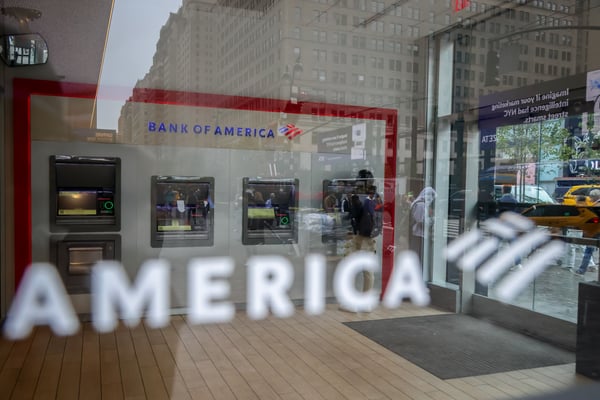
Bank of America (BAC) predicts a significant decline of at least 10% in its investment banking fees for the third quarter compared to the previous year, indicating a broader normalization of capital markets after an unusually robust start to 2026. The firm anticipates fees of around $1.6 billion to $1.8 billion for Q3, down from $2 billion a year ago.
CEO Brian Moynihan noted that the overall investment banking market is also down by approximately 10%, implying that the weaker quarter reflects a cooling in industry activity rather than a company-specific issue. This normalization comes after the second quarter saw a 50% increase in BofA's investment banking fees to $2.1 billion, along with record sales and trading revenue of $7.1 billion.
Despite this, global M&A activity remained substantial in the first half of 2026, with over $3 trillion in announced transactions, suggesting corporate dealmaking appetite has remained strong. Looking at the longer term, the normalization does not necessarily weaken BofA's capital-markets franchise, as investment banking revenues are still well above the depressed levels seen during earlier deal activity downturns.
The bank maintains a substantial pipeline of potential transactions, suggesting some of the current weakness may be timing-related rather than a fundamental loss of demand for M&A, financing, or advisory services. BofA's diversified earnings base, including a 9% increase in net interest income to $16 billion and an 8% growth in average loans and leases, provides a more stable revenue stream as investment banking normalizes.
However, the main risk lies in the potential for this normalization to persist longer than anticipated, which could hinder the sustained growth of revenue and investor expectations. BofA projects fees of $1.6 billion to $1.8 billion for the third quarter, below both the $2 billion generated in the previous year and the $2.1 billion in Q2.
If deal activity continues to moderate, the exceptionally robust growth observed earlier in 2026 could become increasingly challenging to maintain, putting pressure on overall revenue growth and investor expectations. The broader market context also matters, as BofA expects its investment banking fees to decline in line with the estimated 10% industry-wide drop.
While Moynihan indicated that the bank is less exposed to some of the particularly active areas, a shift in the composition of capital-markets activity could limit BofA's ability to capitalize on the recovery's next phase, even if overall M&A and financing volumes remain relatively healthy. In summary, BAC's Q3 outlook should be interpreted as a profile of capital-markets normalization following an exceptionally strong first half, rather than a standalone deterioration in the bank's franchise.
Investment banking fees are expected to decline from elevated levels, while trading revenue is projected to remain flat. However, a robust deal pipeline and diversified banking income offer crucial support for BofA. Investors should weigh whether this is merely a temporary pause after a powerful capital-markets rebound or the start of a longer period of slower deal activity.
While Bank of America is acknowledged as an investment opportunity, the article suggests that certain AI stocks may offer greater upside potential with less downside risk.
Written by urgent.news from Yahoo Finance's reporting — not their text. Machine-written — may contain errors; check the original before relying on it.
This story
This is one outlet's version. Read the fullest account.
- Bank of America Warns of 10%+ Drop in Q3 Investment Banking Fees finance.yahoo.com