Arab Book Award, Arab Publishers Union sign cooperation agreement
<p>Doha: The Arab Book Award and the Arab Publishers Union have signed a cooperation agreement aimed at deepening ties between the two organizations in support of Arabic-language publishing, with plans to expand joint work in events, seminars, and the exchange of professional expertise.</p> <p>The agreement was signed by Executive Director of the Arab Book Award Dr. Naji Al-Sharif, and Chair of…
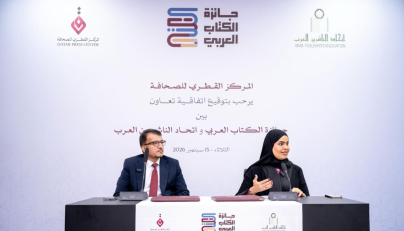
Doha saw the signing of a cooperation agreement between the Arab Book Award and the Arab Publishers Union, with the aim of strengthening their relationship and advancing Arabic-language publishing. The agreement, inked by the Arab Book Award's Executive Director Dr. Naji Al-Sharif and the Chairman of the Arab Publishers Union's Arab Relations Committee Dr. Aisha Jassim Al-Kuwari, will focus on joint efforts in events, seminars, and professional expertise exchange.
The partnership seeks to establish a framework for collaboration across various aspects of the publishing industry, leveraging the expertise of both organizations to support authors, publishers, and institutions involved in the literary world. Dr. Al-Sharif highlighted that this accord builds on previous efforts, including a similar agreement with Oman's Al-Zubair Foundation last year, and anticipates more partnerships with institutions across the Arab region.
Both organizations will work together on author and institutional publishing support, cultural programming, and knowledge-sharing, with the goal of expanding Arabic literature's reach both regionally and internationally. Dr. Al-Kuwari emphasized the importance of this agreement as "an important step" towards joint programming that benefits all stakeholders, and praised the Arab Publishers Union's six decades of experience as a valuable asset for research and industry events.
In discussing contemporary industry trends, Dr. Al-Kuwari addressed the "attention economy," noting that publishers must compete not only for readers' attention but to retain it amidst a deluge of digital content. She argued that the printed book remains relevant, citing the Doha International Book Fair as evidence of the enduring reader-book relationship. E-books, audiobooks, and other digital formats were seen as supplementary to print, rather than direct competitors.
Other speakers echoed similar sentiments, with Dr. Hanan Al-Fayyad of the Arab Book Award stressing the importance of supporting Arabic-authored books for preserving Arab cultural identity, and praising the proliferation of literary prizes in various categories. Ibrahim Al-Buhashem Al-Sayed, Director of Qatar's National Library and Vice President of the Union, highlighted the crucial role libraries play in maintaining print's relevance for younger generations, pointing to outreach programs that connect schools and youth with books and cultural heritage materials.
However, a more cautious perspective was offered by Sadiq Al-Ammari, Director of the Qatari Press Center, who cautioned that the Arab world's self-image as the "nation that reads" may not align with the reality of declining print newspaper, magazine, and book consumption. He warned that strong book-fair sales do not necessarily translate into sustained reading habits, emphasizing that the true test will be whether reading becomes a year-round habit rather than a seasonal event tied to literary fairs.
Written by urgent.news from The Peninsula Qatar's reporting — not their text. Machine-written — may contain errors; check the original before relying on it.