The arcade game just got an AI-powered makeover
Conway’s Arcade looks like the sleekest possible version of the classic arcade cabinet—except it doesn’t run arcade games from the ’80s and ’90s. Instead, it generates games, and the rules behind them, from scratch using Google’s Gemini 3.0. Built by creative agency SpecialGuestX in partnership with production studio 1stAveMachine for Google, Conway’s Arcade is the winner of the 2026 Innovation…
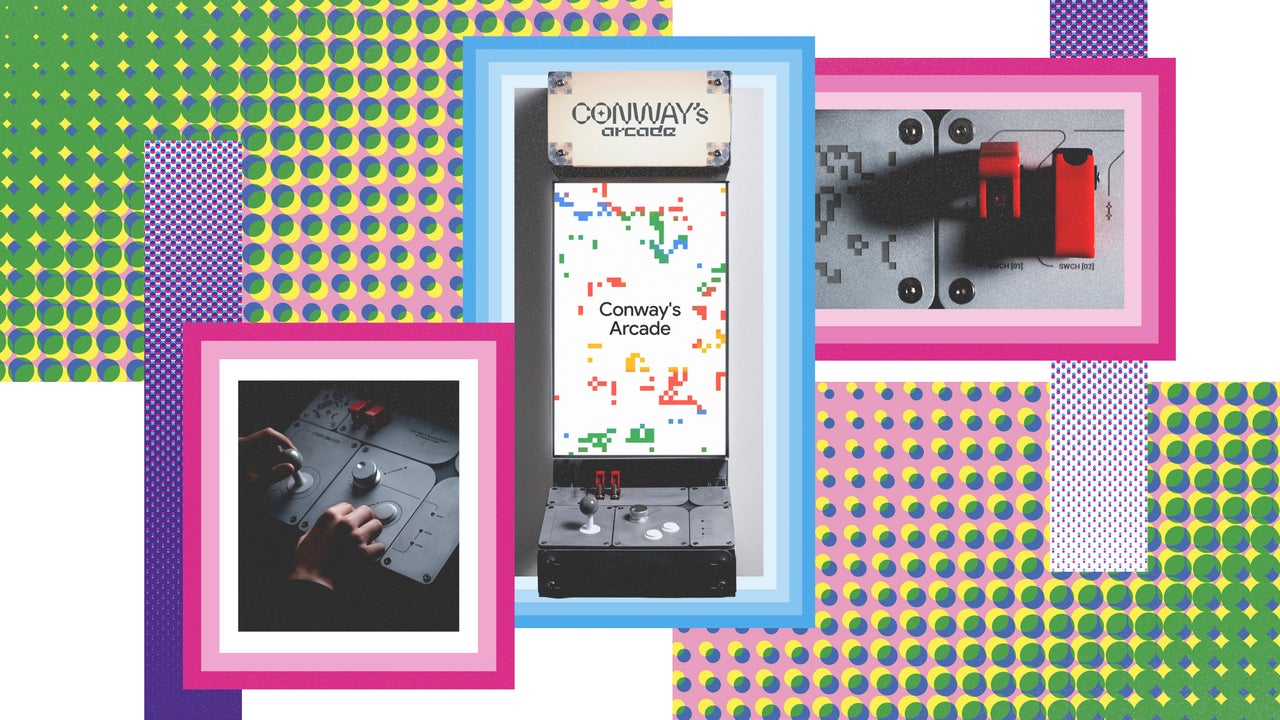
Conway's Arcade is a revolutionary AI-powered machine that generates video games on-the-fly, without relying on classic 80s and 90s arcade titles. The brainchild of creative agency SpecialGuestX and production studio 1stAveMachine, Conway's Arcade is the winner of the 2026 Innovation by Design Awards in artificial intelligence design. It made its debut at NeurIPS 2025, the premier AI research conference.
The project began as an experiment about a year and a half ago, allowing the team to see how models were beginning to program in a serious way. One early test involved users speaking into a microphone, with the model interpreting the request and generating a playable game in real-time. Miguel Espada, SpecialGuestX's executive creative director, says this was a generational fantasy come true, as it was the first time they witnessed models programming effectively.
The first version of Conway's Arcade was an authentic 1980s arcade cabinet, stripped down and rebuilt. It featured a tube screen, rebuilt control board, and a microphone for direct user interaction. When Google showcased the arcade concept at NeurIPS, they wanted to highlight Gemini's code-generation abilities in an engaging way. As a result, the team designed a new hardware iteration for the conference, with its own visual identity crafted in-house.
The game generation process is divided into several layers. When a user speaks their game idea into the microphone, a language model first translates this into a structured game-design prompt, identifying suitable genres based on the input. For instance, a request for a "fighting game between cats and dogs" is analyzed and related to Street Fighter, resulting in a more detailed prompt for generation.
The second layer then creates the game's assets, including sprites generated by an image model called "Nano Banana," along with music and gameplay code. To ensure playability, SpecialGuestX pre-baked key code patterns into the system prompt, providing built-in components like a score counter, timer, player character, and defined input mechanisms.
At the NeurIPS installation, SpecialGuestX pre-rendered a curated selection of machine-generated games, each linked to its original user prompt. Attendees could immediately play these games using a QR code, or generate their own using their phones. Espada acknowledges that the underlying technology has advanced rapidly since the first prototype, and he anticipates future versions capable of producing hyperrealistic 3D games, simply by dreaming up a game and having it materialize.
Written by urgent.news from Fast Company's reporting — not their text. Machine-written — may contain errors; check the original before relying on it.