'Pyramide de Verlée' in Havelange, Belgium
Verlée is a small hamlet located an hour and a quarter's drive south-east of Brussels. Apart from a few limestone farmhouses, the village itself is small and of little interest. However, when leaving Verlée via the road to Petit Avin, visitors are surprised to discover a stone obelisk in the middle of the countryside. It stands on a ridge alongside the road. There are no nearby buildings and no…
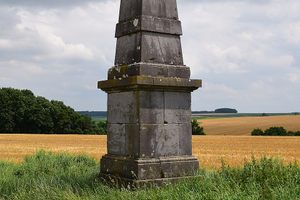
Verlée is a diminutive hamlet situated a quarter of an hour's drive southeast of Brussels. Apart from a few limestone farmhouses, the village itself holds little significance. However, as one leaves Verlée via the road to Petit Avin, an unexpected sight awaits: a stone obelisk in the middle of the countryside. It sits atop a ridge alongside the road, with no nearby structures or signs explaining its presence.
The carved garlands at the top of the obelisk suggest it dates back to the early 19th century, specifically the Empire period.
Attempts to uncover the obelisk's origin via an internet search only serve to deepen the mystery. Numerous websites refer to it as Belgium's only pyramid, yet none provide a satisfactory explanation. A popular theory proposes that the monument was a topographical landmark aiding French colonel Jean-Joseph Tranchot in conducting a triangulation survey of the Rhine region and a portion of northern Belgium between 1801 and 1813.
While this theory seems plausible given the obelisk's visibility on a hilltop and the period matching the carved decoration, it is incorrect. Tranchot's maps, which do not cover this region, have been preserved and disprove this theory.
Upon examining historical maps of the area, a crucial detail emerges: a castle, now vanished, stood 750 meters north-northeast of the obelisk. Known as the Château de Bouillon, it is distinct from the renowned Château de Bouillon in the south of Belgium. Rue Haveligeoule, leading to the obelisk, aligns perfectly with the axis between the two sites. One side of the obelisk is precisely aligned with this axis, making it a focal point for the castle's axis.
This type of monument, marking the end of a castle's axis, is not unique. Similar examples can be found at La Hulpe Castle in Belgium, Het Loo Palace in Apeldoorn, the Netherlands, the Château de Vaux-Le-Vicompte in France, and Wilhelmshöhe Castle in Germany. The design originates from the Palace of Versailles, where the palace's axis extended over eight kilometers, symbolizing the king's power across the realm.
Versailles served as a model for European palaces during the 17th and 18th centuries, leading to the proliferation of grand central axes in French-style gardens and castle grounds.
However, in locations where creating such a monumental axis was impractical, a constructed monument emerged as the central focal point. The Verlée Pyramid is a testament to this phenomenon, serving as a decorative feature in the garden of a long-demolished castle. The obelisk's existence and purpose have been misrepresented by websites, failing to verify the crucial detail about the nearby castle.
Written by urgent.news from Atlas Obscura's reporting — not their text. Machine-written — may contain errors; check the original before relying on it.