Asia-Pacific Powers Global Trade Boom
China and South Korea are driving the surge, but regional growth is slowing. The post Asia-Pacific Powers Global Trade Boom appeared first on Global Finance Magazine .
In the first half of 2026, global goods trade reached a staggering US$13.7 trillion, marking a 12.5% increase compared to the previous year. Asia-Pacific nations spearheaded this global trade surge, with China's goods trade surplus growing and the U.S. goods trade deficit narrowing. However, the pace of trade growth in the Asia-Pacific region is decelerating, as highlighted by UNCTAD's Global Trade Update.
East Asia saw the most robust trade expansion in the first quarter, driven largely by developing economies. While developing economies and South-South trade experienced double-digit growth over the past year, overall trade contracted when East Asia was excluded, primarily due to reduced imports and exports from the Middle East and South Asia.
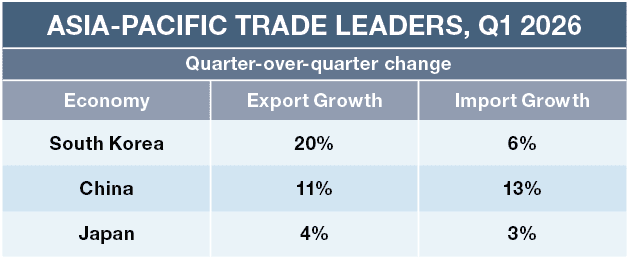
South Korea led in export growth, up 20% quarter over quarter, followed by China at 11% and Japan at 4%. South Korea also emerged as the strongest performer in services exports, expanding by 9%. The Asia-Pacific region's growth is fueled by its thriving automotive manufacturing and AI innovation sectors. Global exports of AI-related goods surged by 280% between 2014 and 2025, reaching a total of $3.8 trillion.
Asia dominates the AI supply chain, accounting for 65% of global AI exports and leading seven of the world's top ten exporters, with China, Taiwan, and Hong Kong contributing the most. New alliances are reshaping trade dynamics, with Canada's trade dependence on China rising while the U.S.-China trade relationship weakens. Meanwhile, East Asian economies, including Thailand and Vietnam, are increasingly reliant on both China and the U.S. Rising energy, transport, logistics, and manufacturing costs have led to trade inflation, with UNCTAD's forecasts indicating a slowdown in GDP growth, particularly in East Asia, due to heavy reliance on energy imports from the Middle East.
China's growth is expected to slow to 4.6%, and Southeast Asia's growth is projected to remain steady at 4.3%. South Asia is expected to maintain its role as the fastest-growing subregion, but GDP growth is forecast to decelerate from 6.3% in 2025 to 5.5%, as rising fossil fuel prices could fuel inflation and financing pressures.
Written by urgent.news from Global Finance's reporting — not their text. Machine-written — may contain errors; check the original before relying on it.