A New Catalog of Close to 3,000 Supernova Challenges Theories on Dark Energy
The most comprehensive catalogue of exploding white dwarf stars ever assembled has revealed new clues about dark energy, the mysterious force driving the universe’s accelerating expansion.
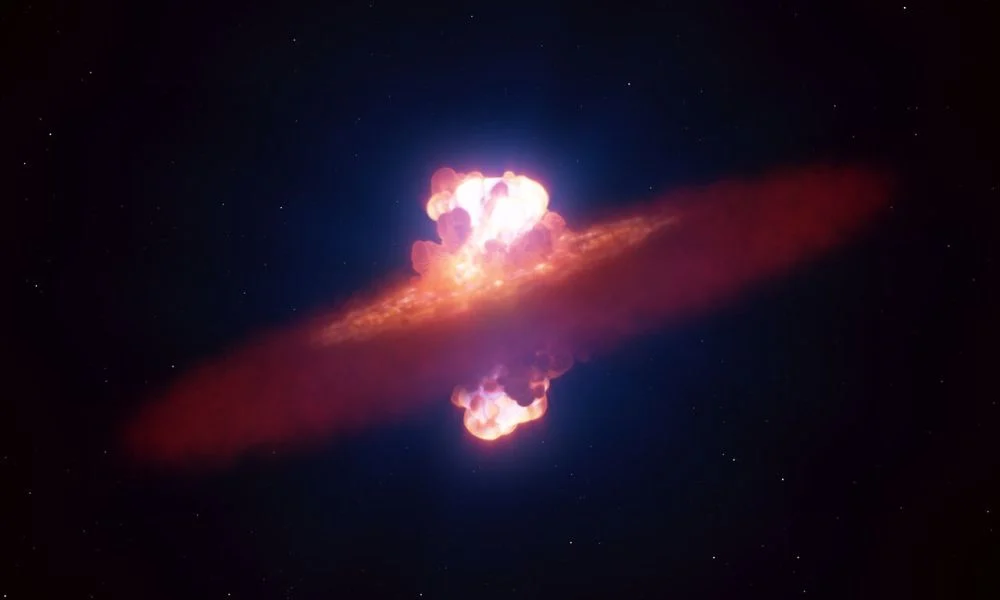
A groundbreaking international collaboration led by researchers from the University of Queensland's School of Mathematics and Physics has compiled the most extensive dataset of Type 1a supernovae to date, comprising 2,884 instances. These supernovae, which can occur approximately once every 500 years, originate in binary systems when a white dwarf accumulates too much material from a companion star or merges with another white dwarf.
The dataset, which combines 30 years of historical observations with contemporary data from the Dark Energy Survey (DES), published in 2024, has challenged the long-held understanding of cosmic expansion driven by Dark Energy.
Dark Energy, the enigmatic force believed to be responsible for the accelerating expansion of the universe, has been presumed to be constant. However, the new dataset suggests that dark energy may not be as steady as previously thought. The researchers, comprising experts from the U.S., UK, Australia, South Africa, Spain, and France, rebuilt decades of astronomical data into a unified framework, analyzing relic light from the Big Bang, galaxy distributions, and accounting for factors like cosmic dust and gravitational lensing.
The team further reanalyzed older supernova data using modern techniques, amalgamating information from various telescopes that study the universe across different wavelengths. The results, as explained by lead researcher Ryan Camilleri, contradict the assumption that the effects of dark energy are constant. Instead, the data indicates that dark energy may change over time, challenging the Standard Model of Cosmology, which assumes the Hubble-Lemaître Constant remains constant.
Professor Tamara Davis, an astrophysicist, highlighted the significance of the dataset in unlocking the true nature of Dark Energy. The findings align with other recent data from the James Webb Space Telescope (JWST) and the Dark Energy Spectroscopic Instrument (DESI), reinforcing the idea that the standard model of cosmology could be incorrect. The research may also provide insights into the interplay between gravity and quantum physics, a crucial step in theoretical physics.
Written by urgent.news from Universe Today's reporting — not their text. Machine-written — may contain errors; check the original before relying on it.