Knowledge Nugget | ‘Sagar Manthan’: Why an indigenous ocean research vessel matters
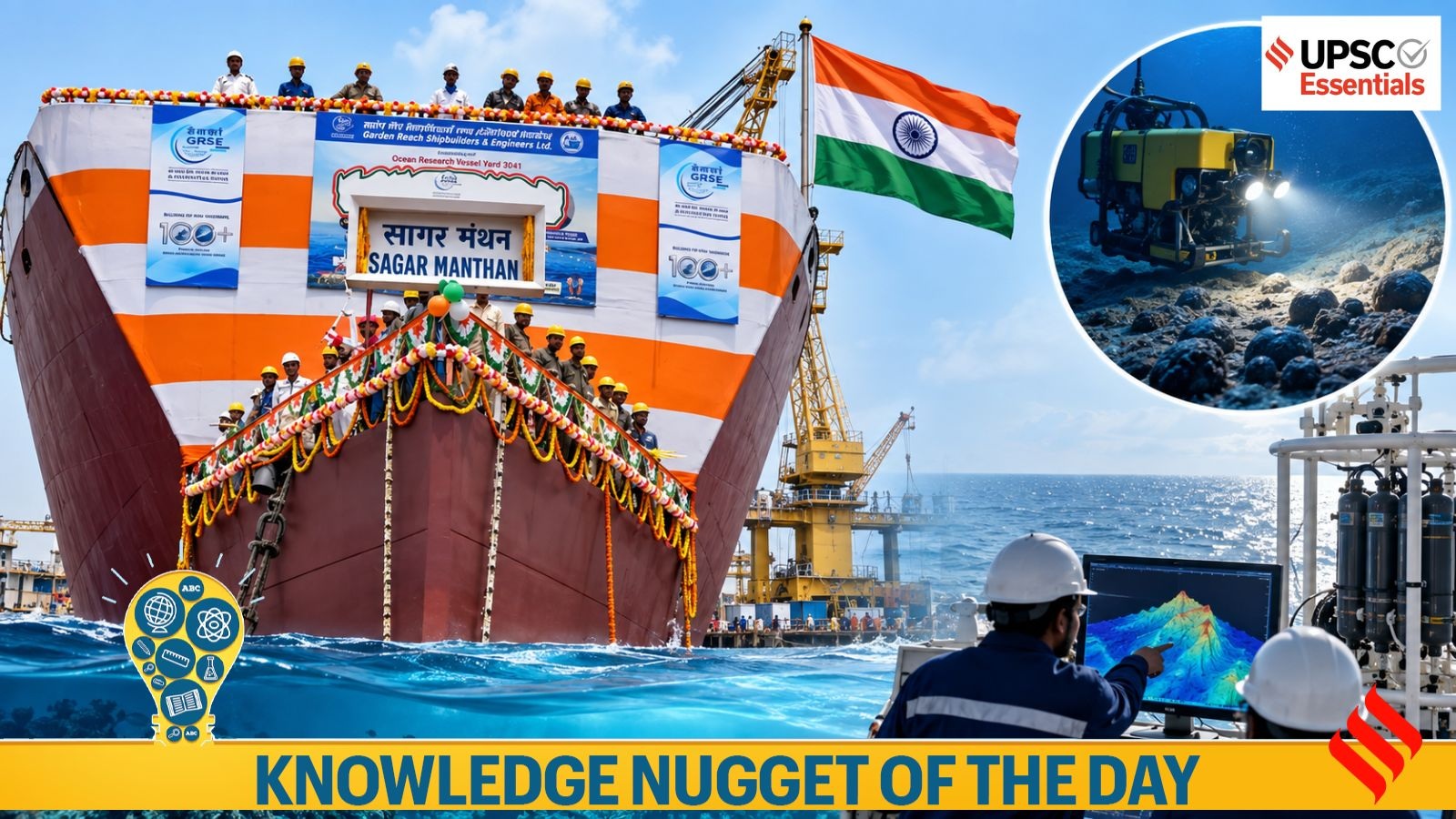
Upcoming Current Affairs Knowledge Nugget: The Sagar Manthan ocean research vessel (ORV) is a significant development in India's deep ocean research capabilities. Launched on September 9, 2026, at the GRSE’s Rishi Bankim Shipyard in Kolkata, the ORV was commissioned by Manju Singh, wife of Dr Jitendra Singh, Minister of State for Science and Technology, and Kavita Ellanti, wife of Dr Srinivas Kumar Tummala, Secretary of the Ministry of Earth Sciences.
Named "Sagar Manthan," meaning "ocean churn," the vessel represents a crucial step in addressing the need for a modern, indigenous research vessel capable of conducting advanced marine research.
With a length of 89.5 meters and a width of 18.8 meters, the ORV boasts a gross tonnage of 5,900 tonnes and a top speed of 14 knots at 90% of its maximum continuous rating. This advanced research vessel has been designed to perform a wide range of scientific operations, including multibeam and geophysical seismic surveys in coastal and deep waters, water sampling, seabed sampling, and the deployment of autonomous underwater vehicles (AUVs) and remotely operated vehicles (ROVs).
The vessel will also support the Indian National Centre for Polar and Ocean Research (NCPOR) in its mission to explore deep ocean resources, such as polymetallic nodules, while advancing climate, biodiversity, and energy research in the deep sea.
Written by urgent.news from The Indian Express's reporting — not their text. Machine-written — may contain errors; check the original before relying on it.