Jewish institutions' security spending tops $1 billion as antisemitism persists
Antisemitic threats have pushed the nationwide cost of protecting Jewish synagogues, schools and community centers past $1 billion a year, new estimates reveal as congregations prepare for big crowds during the High Holy Days , which began Friday with Rosh Hashanah. Why it matters: Enhanced security has become a growing expense for Jewish communities, congregation leaders say, often taking up…
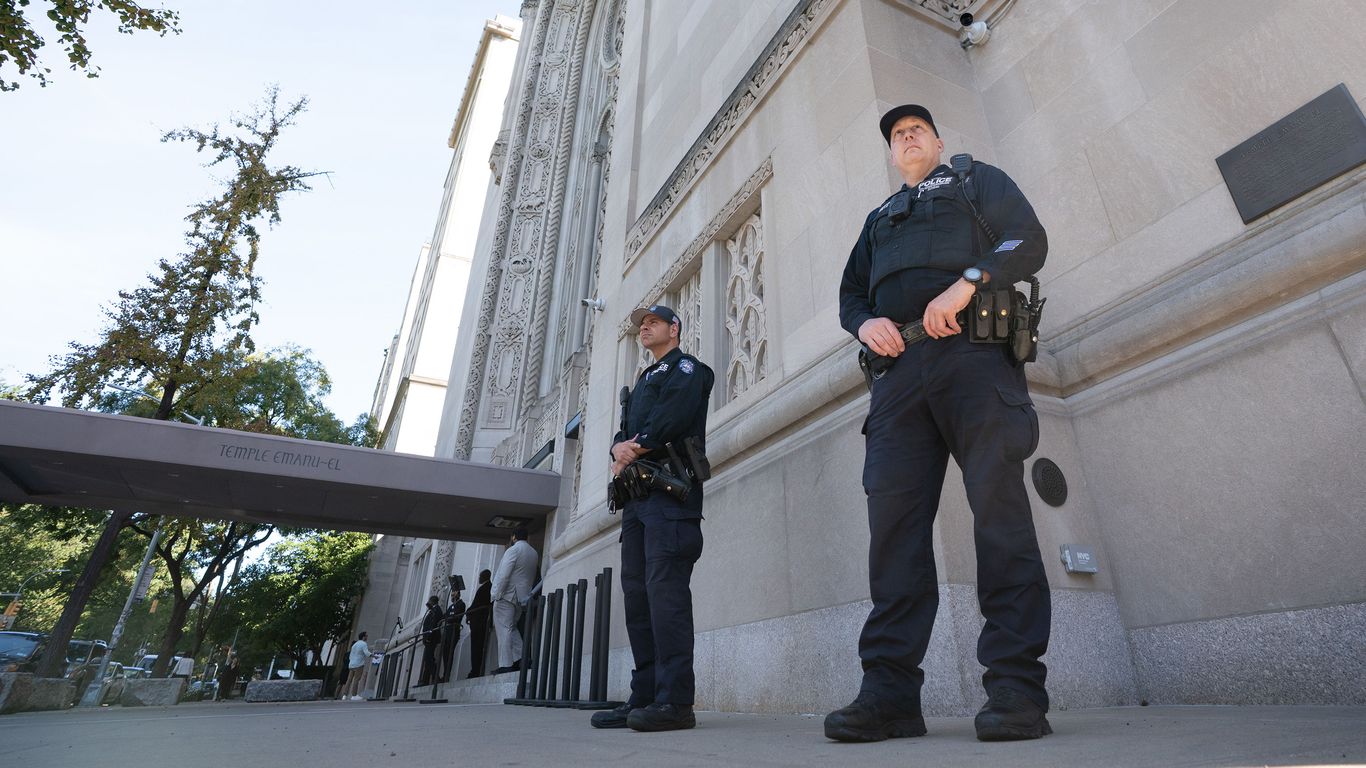
The cost of safeguarding Jewish institutions against antisemitic threats has surpassed $1 billion annually in the United States, according to recent estimates. The Jewish Federations of North America (JFNA) reported a record-high spending of $1.02 billion on security for Jewish synagogues, schools, and community centers. This surge in security spending, up 33% from $765 million in 2024, comes as congregations gear up for major religious gatherings, including the High Holy Days that commenced with Rosh Hashanah on Friday.
A significant portion of this budget, around $150 million, is allocated to security technology and building enhancements such as cameras, reinforced doors, and controlled-entry systems. Additionally, maintaining existing security equipment consumes a substantial share of the funds. The total security expenditure does not account for the costs related to more than 1,600 kosher restaurants, 500 kosher markets, and other privately owned Jewish enterprises.
To address the mounting security challenges, synagogues are increasingly adopting comprehensive, year-round security systems that involve trained congregants, hardened entrances, and coordination with local law enforcement. As of now, over 7,100 volunteers assist in protecting more than 500 synagogues and events weekly. However, this heightened security comes at a price, diverting funds that could be allocated to other vital programs like education, elder care, and community services.
The rise in security spending is a direct response to the escalation in antisemitic assaults, which have reached their highest level since the Anti-Defamation League began tracking them in 1979. While the FBI reported a 21% increase in anti-Jewish hate crimes in 2025 compared to the previous year, the ADL noted a 33% decline in overall antisemitic incidents last year, though physical assaults reached a 46-year high.
The disparity in these statistics highlights the complex and evolving nature of antisemitic threats in contemporary society.
The JFNA's executive director, Eric Fingerhut, acknowledged the trade-off involved in prioritizing security over other community needs, stating that every dollar spent on security is a dollar not spent on Jewish education. This financial dilemma underscores the broader challenge faced by Jewish communities in balancing security measures with other crucial community investments.
Written by urgent.news from Axios's reporting — not their text. Machine-written — may contain errors; check the original before relying on it.