AI trained to 'think' like human pathologists may be better at spotting cancer
Researchers trained AI on how expert pathologists look for signs of cancer in patient samples, improving the algorithm's effectiveness.
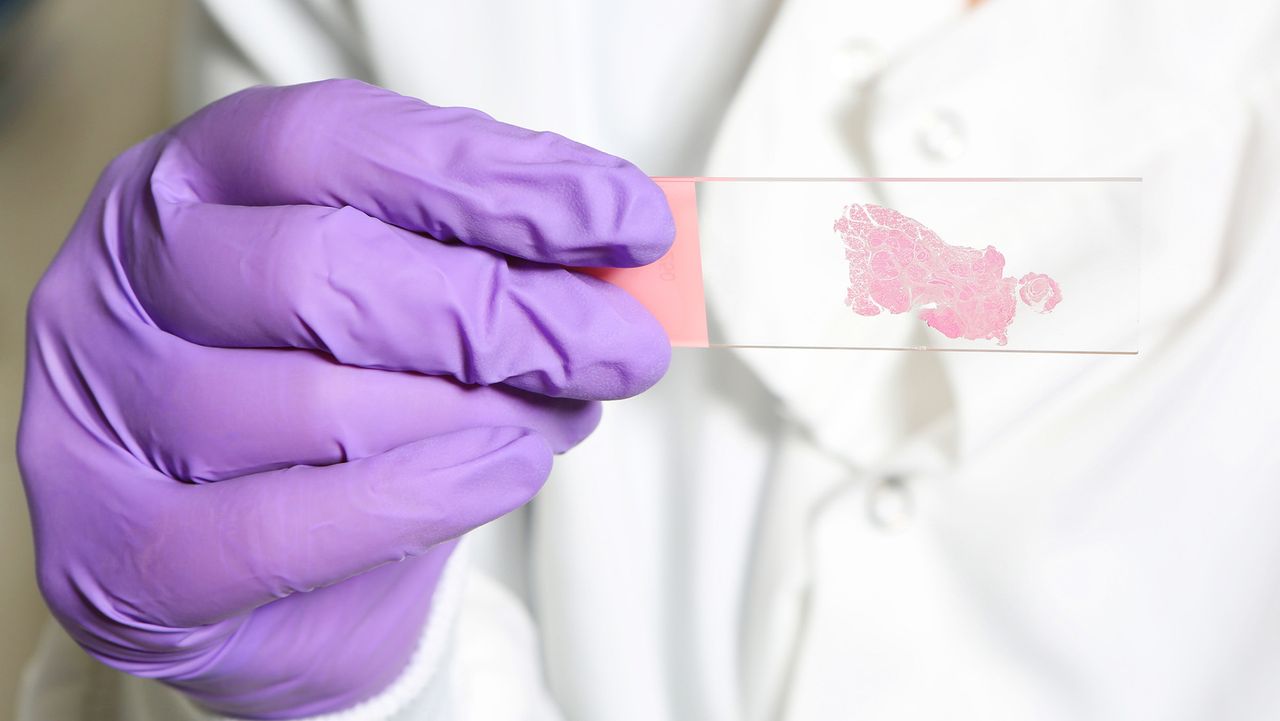
A new study suggests that artificial intelligence (AI) algorithms trained to think and act like human pathologists may have an edge when it comes to spotting cancer in tissue samples. Traditional AI systems often focus on preselected regions or split slides into fixed-size patches, but a pathologist analyzes a slide more dynamically, zooming in and out and pausing over areas of interest.
Zhi Huang, an assistant professor of pathology and laboratory medicine at the University of Pennsylvania, compared this process to a search-and-rescue helicopter. Rather than starting by inspecting one square meter of ground, Huang told Live Science, the helicopter scans the landscape first and then swoops in for a closer look.
To train the AI to mimic this human behavior, researchers developed a technique called Pathology-CoT, short for "chain of thought." This approach converts the observable actions of pathologists, such as where they move around an image and where they zoom in, into training data. The team created a tool to record these actions from eight pathologists, cleaning up the data to focus on deliberate attention moments.
Using this training method, the researchers built a new tool called Pathology-o3. This tool scans a slide at low resolution, selects regions worth a closer look using a model trained on pathologists' behavior, and then sends higher-resolution views of those regions to a vision language model (VLM) for analysis.
In tests comparing Pathology-o3 to other general-use AI systems, Pathology-o3 correctly identified slides containing cancer 100% of the time. However, some of its positive results turned out to be false alarms, with 15.5% of identified positive slides being actually negative. In contrast, the other general-use AI system, OpenAI o3, correctly identified 87.5% of cancer-positive slides, but with a higher false positive rate of 53.3%.
The researchers designed Pathology-o3 to err on the side of flagging regions for further examination rather than potentially missing cancer. While this approach may result in more false positives, it could still be useful for guiding pathologists to inspect specific regions of a slide. The study also found that Pathology-o3 maintained its performance when tested on new datasets, indicating its potential applicability across different medical scenarios.
However, further research is needed to determine whether using this tool would make pathologists more accurate or efficient in practice.
Written by urgent.news from Live Science's reporting — not their text. Machine-written — may contain errors; check the original before relying on it.