Scientists discover mysterious new X-ray objects 'unlike any they have seen before'
Faint in X-rays but bright in ultraviolet light, new objects found by NASA's Chandra space telescope could help solve two great astrophysical mysteries.
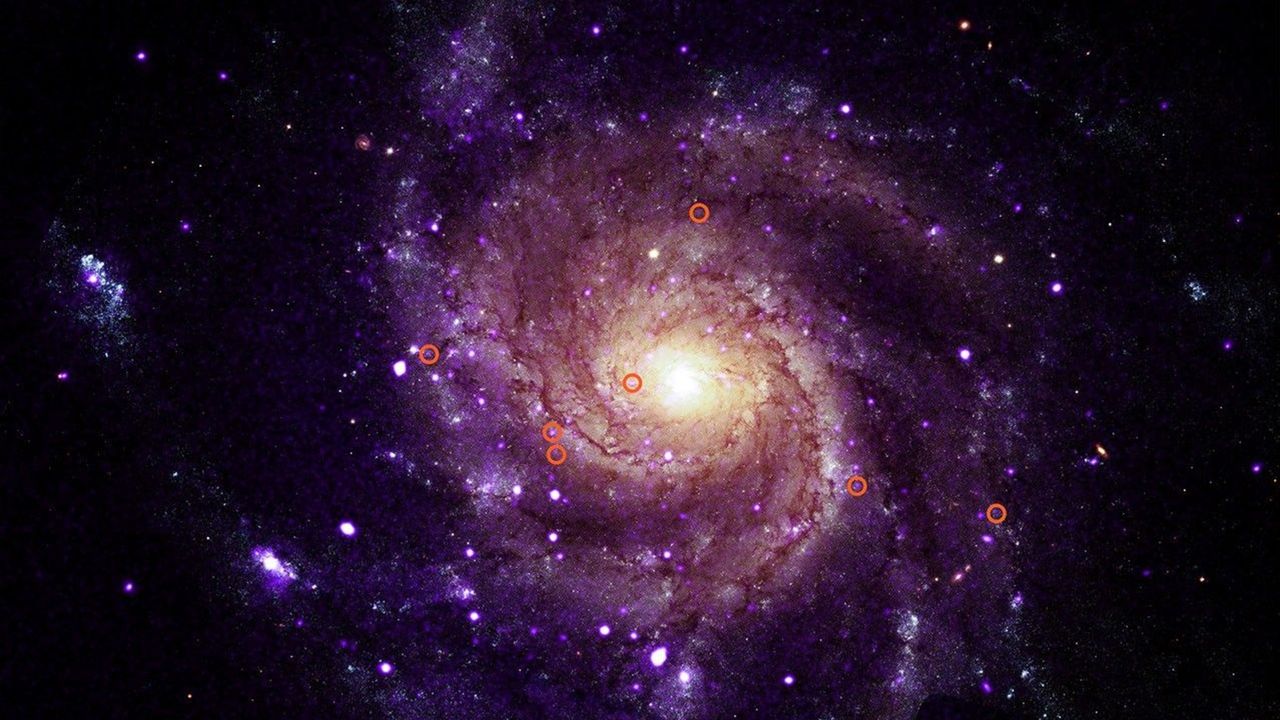
NASA's Chandra X-ray Observatory has discovered a novel type of compact binary system, one that emits very low-energy X-rays while also emitting large amounts of ultraviolet light. The researchers identified 84 such objects spread across six galaxies, including our neighbor Andromeda and the Pinwheel Galaxy. These new entities, dubbed "hypersoft X-ray sources," are comprised of compact objects such as black holes, neutron stars, and white dwarfs, which steal gas from companion stars.
The stolen gas, in turn, produces torrents of high-energy X-rays due to its superheating by the compact object's gravitational force. However, these hypersoft X-ray sources emit far less X-ray radiation than typical counterparts, leading researchers to suspect they are lower-level compact binaries. The low-energy X-rays and ultraviolet light are adjacent on the electromagnetic spectrum, prompting the scientists to posit that the low-energy X-rays may be leakage from objects emitting immense amounts of ultraviolet radiation.
The researchers hypothesize that these objects are classed as lower-level compact binaries, which are challenging to detect due to the absorption of ultraviolet light by the interstellar medium of hydrogen and helium gas in galaxies. Given the prevalence of these enigmatic X-ray sources, they could be influencing the composition of the universe around them.
These hypersoft X-ray sources are among the most energetic objects in galaxies and may hold the key to solving two enigmas in astrophysics. Firstly, there is an excess of ionization in the interstellar gas, which high-energy ultraviolet light from hot, massive stars could potentially explain. Secondly, these sources may be regulating star formation within galaxies.
They also shed light on the process behind type Ia supernova explosions, which occur when white dwarfs accrete matter from a binary companion and exceed the Chandrasekhar limit. Understanding the mechanism behind these explosions could enhance our knowledge of dark energy and the expansion of the universe, as well as potentially allow us to detect type Ia supernova explosions before they occur.
Written by urgent.news from Space.com's reporting — not their text. Machine-written — may contain errors; check the original before relying on it.