Non-reciprocal interactions keep particles in collective motion
New finding could help create active matter with a structure that continuously reorganizes itself The post Non-reciprocal interactions keep particles in collective motion appeared first on Physics World .
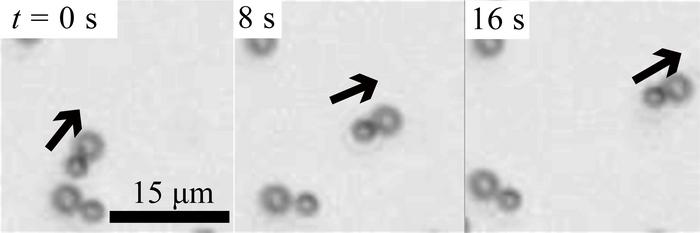
Non-reciprocal interactions between particles are causing them to maintain a collective motion, according to research led by Yutaka Sumino and Kiwamu Yoshii at Tokyo University of Science. This behavior occurs when one particle influences another more strongly than it is influenced, a phenomenon known as non-reciprocal interactions. The study, published in Physical Review Letters, demonstrates that these forces can lead to self-propelled particle pairs instead of particles aggregating.
The researchers worked with polystyrene colloidal particles of different sizes – 1 and 1.5 micrometers – suspended in water between electrodes. By applying an alternating electric field, they were able to observe electrohydrodynamic flows and asymmetric attractive interactions, where larger particles attracted smaller ones more strongly. This led to non-reciprocal interactions, meaning larger particles pushed smaller ones but were not pushed back.
The asymmetry in these interactions caused the particles to form self-propelled pairs, which behaved like individual units moving through the suspension. When more self-propelled pairs formed, they joined together to create clusters, but these clusters did not continue to grow or remain static. Instead, they would fragment and reorganize, preventing continuous coarsening of the system.
The researchers noted that the larger particle tended to be at the front of these moving pairs, which they attributed to head-heavy size asymmetry and excluded-volume interactions. These findings suggest that non-reciprocal interactions can serve as a general design principle for creating active materials that continuously reorganize rather than simply relaxing towards a static state.
While the current study focused on colloidal particles, the researchers aim to explore if similar mechanisms can be found in other experimental systems.
Potential applications of this understanding could include programmable active materials and microrobotic systems, although these are still far from realization. The research team hopes to further investigate the generality of non-reciprocal mechanisms and their implications for controlling collective motion in various systems.
Written by urgent.news from Physics World's reporting — not their text. Machine-written — may contain errors; check the original before relying on it.