Energieversorgung: Emirate knüpfen Gas-Lieferungen nach Deutschland an Bedingungen
Deutschland und die Vereinigten Arabischen Emirate wollen ihre wirtschaftliche Zusammenarbeit intensivieren. Beim Thema Gas sehen die Emirate ein Problem.
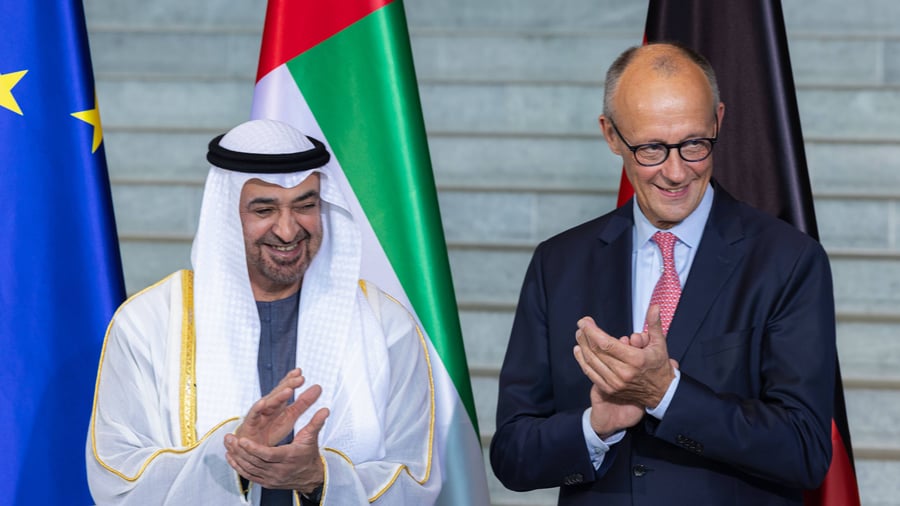
The recent visit of Sheikh Mohamed bin Zayed Al Nahyan, the President of the United Arab Emirates (VAE), concluded on Friday with several investment announcements and agreements. Energy sector cooperation is of particular importance in this context. However, there are obstacles. The German state gas importer Sefe signed a Memorandum of Understanding (MoU) with Adnoc, the state energy and chemicals conglomerate of the Emirate, and XRG.
XRG is Adnoc's international investment company. In the joint statement, the three companies aim to explore "cooperation possibilities along the natural gas and LNG value chain." Nevertheless, the existing European Union (EU) regulations pose a challenge for cooperation. Rainer Seele, President of Global Chemicals at XRG and supervisory board member of the German chemicals group Covestro, explained to Handelsblatt: "The EU's Methane Regulation conflicts with the EU itself distancing from relevant supply sources."
The EU Methane Regulation aims to reduce climate-harming methane emissions along the gas and oil value chain. Initially, gas and oil producers will be required to measure emissions. "Read also: Emirate to invest an additional 40 billion euros in Germany – New direct link to Berlin. The regulation will be progressively tightened in the coming years.
Later, emissions will have to be systematically reduced. Violations face significant penalties. Major liquefied natural gas (LNG) producers like the United States and Qatar have already declared they do not intend to comply with the EU regulation. Yet, the EU Commission aims to prevent the complete suspension of the regulation. Instead, it proposes that penalties not be imposed for the first violation.
Seele believes this is not enough: "Suspension of the regulation is not enough. It must be completely removed from the agenda." Furthermore, Europeans should accept long-term supply contracts, according to Seele: "Long-term supply contracts are essential. Only with long-term supply contracts can billion-dollar investments be justified."
The issue is controversial in the EU. Critics of long-term supply contracts argue that 15- or 20-year contracts hinder European climate goals and entrench dependence on fossil energy sources. Seele emphasized the significance of the recently signed MoU: "We have a strong interest in close cooperation with Sefe. Our takeover of Covestro at the end of 2025 demonstrates that we consider Germany an important partner.
It is the largest single investment by XRG." Seele added that XRG aims to become a relevant global player in the LNG market. "We cover the entire LNG value chain and value diversification. We are advancing projects in the USA, Mozambique, and Argentina," he stated. Seele believes XRG can benefit from this diversification. Seele stated that XRG has set the goal of becoming a relevant global player in the LNG market.
"We cover the entire LNG value chain and value diversification. We are advancing projects in the USA, Mozambique, and Argentina," he stated. The VAE announced an investment package of 40 billion euros in Germany. The collaboration in the areas of economy, energy, environment, defense, and defense technology is to be expanded. A total of 29 MoUs and agreements between German companies and VAE companies were announced during the state visit.
RWE, an energy corporation, and the state-owned renewable energy conglomerate Masdar signed an MoU to review collaboration on German offshore wind tenders. RWE and Adnoc also agreed to discuss long-term LNG supply possibilities for Germany and Europe.
Written by urgent.news from Handelsblatt's reporting — not their text. Machine-written — may contain errors; check the original before relying on it.