China's robot champion races towards real-world work
A WEEK after his robot outran humanity’s fastest man, Jack Guo is already chasing a harder goal.
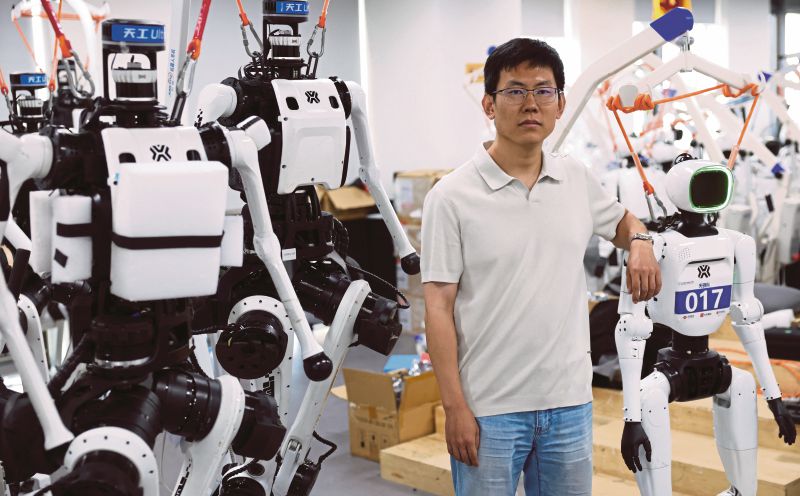
A week after his robot Ultra set a world record for humanoid speed by covering 100 meters in 8.64 seconds, Jack Guo, the lead developer at Beijing's X-Humanoid Centre, is already eyeing a bigger challenge - turning high performance into high reliability and usability. The robotic champion's feat at the World Humanoid Robot Games stunned spectators, who witnessed Ultra outpace Usain Bolt's world record by nearly a full second.
Guo, who directs the development of both Ultra and Omni, a smaller robot used in the 400-meter race, expressed his excitement about Ultra's performance during the race. "When it started smoothly and got past 50 meters, that was when I finally relaxed," he said. As the engineer focuses on improving the reliability and usability of their creations, the story highlights China's growing lead in humanoid robotics, spurred by state-backed research, robust supply chains, and fierce competition.
X-Humanoid, situated in Beijing's high-tech district Yizhuang, showcases a range of TianGong robots, including Ultra and Omni. Established in November 2023, X-Humanoid is backed by state-owned and private investors, alongside tech giants Xiaomi and Baidu. The center develops hardware, motion-control software, and artificial intelligence (AI) for the industry, while also commercializing its own robots for universities, research institutes, and companies exploring industrial applications.
Originally designed to push the boundaries of humanoid movement, Ultra was not initially intended for racing. Guo compares today's humanoid robots to early cars, emphasizing the need to first make them controllable before equipping them with reliable bodies and intelligent AI brains to handle complex tasks independently. The development of generalised mobility through robot running has proven beneficial, as demonstrated by Omni, which recently climbed from the first floor to the 17th floor of X-Humanoid's headquarters.
Looking ahead, Guo expects smaller humanoid robots to find early roles in commercial services and light industry, while Ultra could eventually be employed for outdoor inspections or emergency rescues. At the recent World Humanoid Robot Games, Ultra employed three different running strategies trained in simulation, with each race employing a trained motion-control system that continuously adjusts joints and balance to allow upright sprinting without a direct operator's guidance.
Written by urgent.news from New Straits Times's reporting — not their text. Machine-written — may contain errors; check the original before relying on it.
Also reported by 1 other outlet
- I spent $4,000 on a robot dog from China arstechnica.com