Can Africa seize its moment in the race for critical minerals?
The intensifying global competition for critical minerals could be a transformative moment for Africa.The continent is already a major producer of energy transition metals such as copper, cobalt and m...
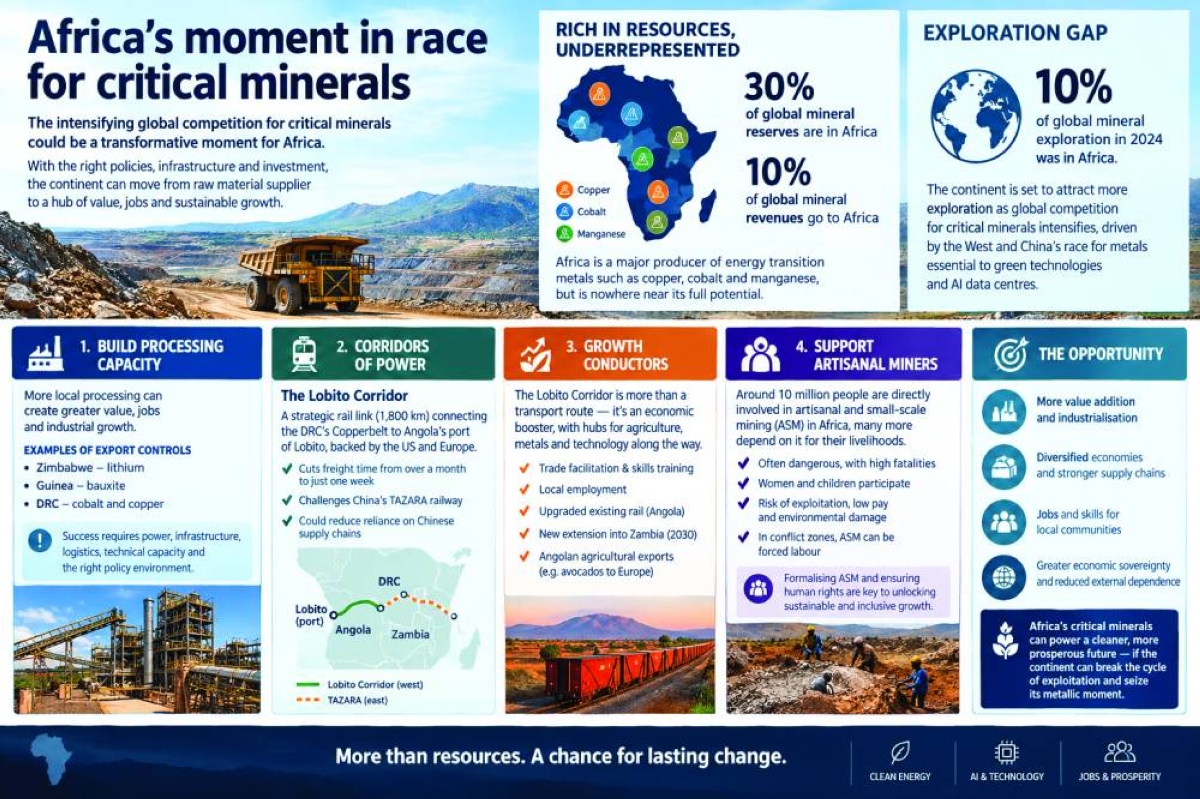
The escalating global race for critical minerals presents a potential turning point for Africa. Despite being home to 30% of the world's mineral reserves, the continent only generates 10% of the global mineral revenues. This disparity stems from a legacy of resource extraction by external powers, which has long sidelined African nations in the value chain. However, African governments are now recognizing the opportunity to reclaim control over their resources and reshape the terms of trade.
To seize this opportunity, Africa must shift from merely exporting raw materials to developing processing capacity. Indonesia serves as a prime example, where a ban on nickel ore exports in 2020 forced miners to invest in smelters, propelling the country to become the world's leading producer of nickel products, including refined metal and sulphate for battery manufacturers.
Several African nations have adopted similar strategies, such as Zimbabwe's export controls on lithium, Guinea's on bauxite, and the Democratic Republic of Congo's on cobalt and copper. These measures aim to leverage raw materials to expand domestic processing capacity. Nevertheless, numerous obstacles stand in the way of establishing a successful processing business, including power supply, infrastructure, logistics, technical capacity, and policy. Factors such as these can be more significant than the mineral reserves themselves.
Angola exemplifies the potential for processing projects. Despite lacking bauxite or the processing capacity to convert it into alumina, the country is constructing an aluminium smelter at the port of Barra do Dande. The project benefits from a deep-sea port, strategic location, favorable business rates, and reliable power supplies.
Furthermore, Angola's involvement in the Lobito Corridor, a massive infrastructure project backed by both the US and Europe, highlights its commitment to breaking free from external power influence. The corridor, which will connect the Copperbelt region with the Angolan port of Lobito, promises to reduce freight time and create economic opportunities along its 1,800-kilometer route.
By combining hard infrastructure with soft connectivity, the Lobito Corridor aims to transform Africa's resource sector into a catalyst for regional growth and development.
Written by urgent.news from Gulf Times Business's reporting — not their text. Machine-written — may contain errors; check the original before relying on it.