Ancient Swedish Goths Had Surprisingly Accurate Calendars
Ancient Swedish pagans had surprisingly accurate calendars and the ability to measure phases of the Moon to an incredible precision.
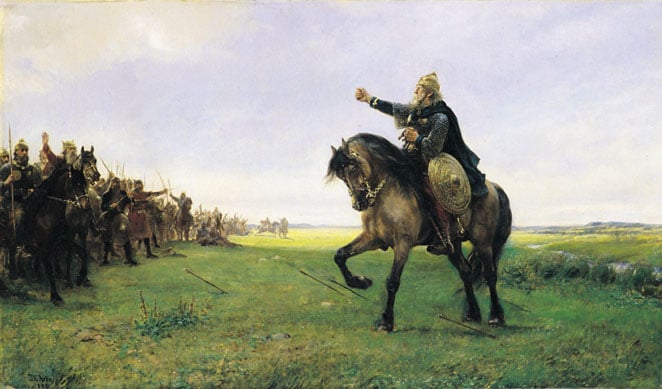
In 2014, Swedish astrophysicist Goran Henriksson discovered that a group of ancient Goths, who lived around 2,500 years ago, had an exceptionally accurate calendar system. These northern Germanic pagans worshipped ancestors of Odin, Freyr, and Thor, and performed gruesome midwinter sacrifices every eight years if they didn't. The sacrifices began at the height of winter, approximately from February 6 to 8.
Henriksson claims to have found the calendar that regulated these sacrifices, which were believed to be essential for avoiding catastrophe in the following eight years.
Archaeologists found two rows of poles marking the northern limit for the rising of the full moon and the direction of the rising sun when the sacrificial cycle began. The sacrifice was timed according to a full moon that occurred between January 28 and February 26 in the Gregorian calendar. Henriksson's research, presented at the 2014 European Society for Astronomy in Culture, established the exact years of the eight-year cycle, including one that began in AD 852.
The burial mounds, located in Old Uppsala, were oriented in a way that could have been used to regulate the sacrificial calendar. The 850-meter-long row of poles was aligned with the northern limit for the rising midwinter full moon, while the 600-meter-long row was oriented toward the rising sun from February 6 to 8. The sacrifices involved one man and seven male domestic animals being sacrificed over a nine-day period, with 72 bodies hanging upside down in a holy tree.
Despite their barbaric behavior, these Goths had a sophisticated understanding of the celestial sphere and natural world. Their religious beliefs and belief in an afterlife drove their pursuit of precision in calendrics, surpassing even the Catholic Church's calendar hundreds of years later.
Written by urgent.news from Phys.org's reporting — not their text. Machine-written — may contain errors; check the original before relying on it.