What Is Math’s Mysterious Langlands Program Really About?
Hidden correspondences hint at a deeper structure to the mathematical universe. Our columnist unpacks one of those connections and asks mathematicians what they might mean. The post What Is Math’s Mysterious Langlands Program Really About? first appeared on Quanta Magazine
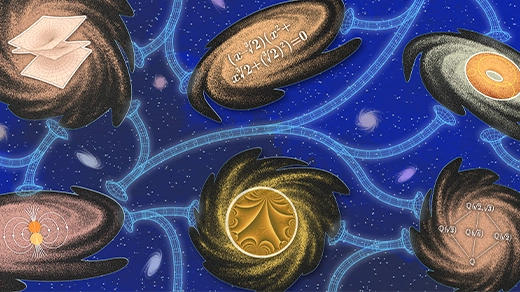
The Langlands program is a vast and interconnected framework in mathematics, often described as a "grand unified theory" for the diverse mathematical domains. Developed by Canadian mathematician Robert Langlands in 1967, it seeks to establish correspondences between seemingly disparate areas, such as number theory and harmonic analysis. These correspondences, known as Langlands correspondences, reveal unexpected symmetries and relationships between objects, symmetries, and properties across various mathematical realms.
Though experts find it challenging to explain the Langlands program succinctly, some compare it to "wormholes" linking distant mathematical concepts. The program's intricacy lies in its specificity and the esoteric nature of its mathematical correspondences. It extends the rational numbers, denoted as $\mathbb{Q}$, by incorporating solutions to polynomial equations with irrational solutions, forming new number fields that maintain a unique symmetry.
This symmetry transformation, akin to reflecting the field in a mirror, is governed by the Galois group of the equation, named after Évariste Galois. The Galois group encapsulates the symmetries that reveal profound insights into equations and their solutions, even for those that are mathematically intricate. The Langlands program's deep connections hint at a profound unity between mathematical and physical realities, though the full extent of its implications remains an ongoing exploration.
Written by urgent.news from Quanta Magazine's reporting — not their text. Machine-written — may contain errors; check the original before relying on it.