This 'impossible' black hole merger may be explained by a warp in spacetime
A "forbidden" merger between two black holes may not have been quite as impossible as previously thought. New research that suggests the black holes involved were smaller than first calculated.
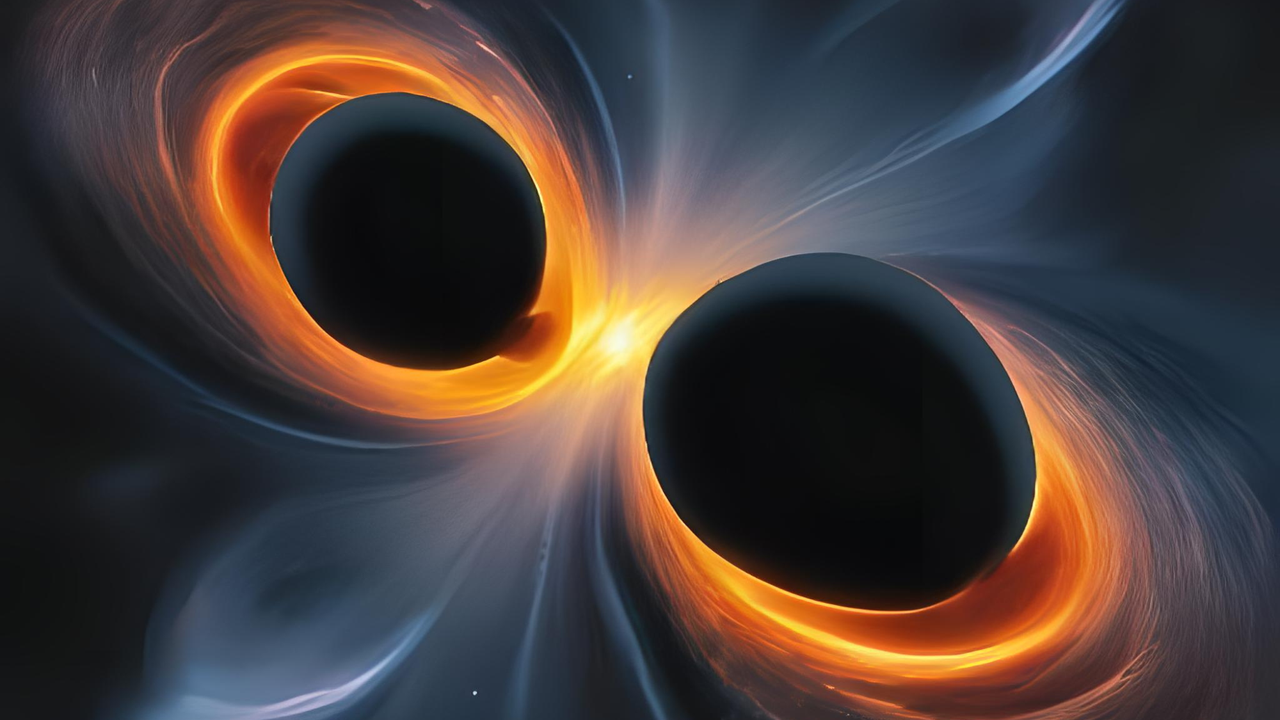
A recent study challenges the notion that a colossal black hole merger observed on November 23, 2023, was an unprecedented cosmic event. According to the research, the black holes involved were likely smaller than initially believed. On that day, the Laser Interferometer Gravitational-Wave Observatory (LIGO) detected gravitational waves (GW231123), which are ripples in spacetime caused by the collision of two black holes.
The masses of the black holes—140 and 100 times that of the sun—were strikingly large, and their high rotational speeds posed a mystery for astrophysicists.
The research team suggests that gravitational lensing, a phenomenon predicted by Albert Einstein's 1915 theory of general relativity, may be responsible for the apparent size of the black holes. Gravitational lensing occurs when the mass of an object distorts the fabric of spacetime, bending the path of light traveling near it. In this case, the team proposes that a massive object, possibly a compact one weighing between 190 to 850 solar masses or an extended structure like a globular cluster, was warping the spacetime around the black holes, making them appear larger than they actually are.
By modeling this gravitational lensing scenario, the researchers were able to explain the observed high masses without resorting to unusual spin rates for the black holes. Their simulations indicated that the merger involved a system with a mass of 140 solar masses, rather than the initially proposed 240-solar-mass system. However, the exact nature of the lens remains a mystery, as compact objects with the required mass are extremely rare.
Further investigations, possibly involving upgrades to the sensitivity of gravitational wave detectors like LIGO, will be necessary to confirm whether GW231123 is indeed a gravitationally lensed signal. Regardless, this research underscores the potential of gravitational wave astronomy to unlock the secrets of the universe's most violent events.
Written by urgent.news from Space.com's reporting — not their text. Machine-written — may contain errors; check the original before relying on it.