GitHub Puts Guardrails on Copilot’s Sandbox Inside JetBrains IDEs
JetBrains IDEs are where a lot of enterprise backend work happens — Java, Kotlin, Spring, big monorepos with a lot to break. So when an AI coding agent starts running shell commands inside that environment, the question isn’t whether it’s useful. It’s what happens if it touches the wrong file, the wrong network path, or […]
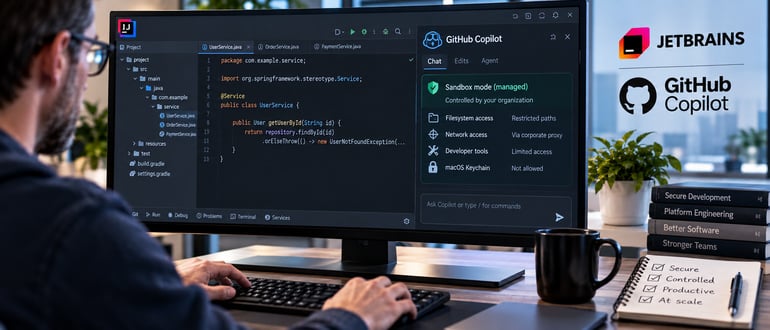
JetBrains IDEs host a significant portion of enterprise backend development, involving complex systems like Java, Kotlin, and Spring frameworks. When an AI coding assistant like GitHub Copilot executes shell commands within this environment, concerns arise about potential damage to the wrong files, network paths, or sensitive credentials. To address these issues, GitHub has introduced guardrails for Copilot's sandbox within JetBrains IDEs, providing administrators with centralized control over the sandbox boundary.
The new sandbox policies enable IT teams to set specific parameters for Copilot sessions, such as whether sandboxing is enabled, the accessible filesystem and network paths, routing through proxies, interaction with developer tools, and access to tools like Mac Keychain. Once an administrator locks a setting, it is marked as "managed" and cannot be altered by developers locally.
This development follows GitHub's previous provision of local and cloud sandboxes for Copilot CLI, which allowed developers to restrict agent reach on their machines or offload tasks to ephemeral cloud Linux boxes. Previously, enterprise control over sandbox policies was achieved through general-purpose Mobile Device Management (MDM) tools.
However, GitHub has now integrated sandbox policy directly into the Copilot plugin's managed settings, allowing for quicker adjustments without the need for extensive device management changes.
Additional features introduced alongside the sandbox controls include a policy diagnostics tool for verifying managed settings' enforcement on developer machines, an enhanced Copilot's next-edit suggestion that can span multiple files, project-wide chat context retrieval instead of individual file attachments, and the ability for the Copilot CLI's /ide command to connect to a JetBrains terminal session, mirroring the IDE's selections and diagnostics.
Mitch Ashley, a prominent figure in the IT industry, emphasizes the importance of sandbox policies in a broader context of AI coding tools. He notes that once an agent can execute commands, edit across files, and access the network independently, the IDE transforms into a runtime requiring comprehensive access controls, similar to other systems handling production code.
The introduction of a diagnostics tool to confirm policy enforcement signifies a critical shift in how enterprises approach the verification of AI coding tool access controls.
This latest update is part of GitHub's ongoing effort to enhance governance over Copilot's agentic features, following a series of releases over the summer. These include managed plugin lists, MCP server allowlists, and telemetry routing. The consistent pattern of rolling out new governance features alongside the agentic capabilities of Copilot indicates a proactive approach to ensuring security and control over these powerful tools.
For engineering and platform teams utilizing JetBrains at scale, the practical recommendation is to leverage the new policy diagnostics tool before enabling any autonomous modes of Copilot and to verify that the configured sandbox policies are effectively implemented on developer machines.
Written by urgent.news from DevOps.com's reporting — not their text. Machine-written — may contain errors; check the original before relying on it.