Archaeologists Excavating a Roman-Era Cemetery in Poland Were Surprised to Stumble Upon a 5,000-Year-Old Necklace Made of 42 Teeth
Crafted from the teeth of large mammals, such as wolves, deer, bears and perhaps even humans, the jewelry was found in a grave in southern Poland that may belong to an important patriarch of the Corded Ware culture
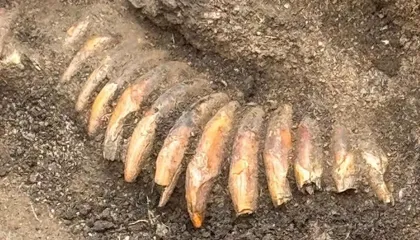
Archaeologists unearthing a Roman-era cemetery in southern Poland made an unexpected discovery— a 5,000-year-old necklace crafted from 42 sharp teeth. The grave, located near Żórawina, was found by researchers from the University of Wrocław and Wrocław Medical University. The site is known for its Roman-era cemetery dating back to the fourth or fifth century C.E.
While investigating the Roman graves, the researchers stumbled upon a barrow—a burial mound. Excavation revealed a tightly arranged row of single-peaked teeth, each drilled through at the root, suggesting the teeth were once strung together on a now-decayed rope. This unique find is believed to be connected to the Corded Ware culture, known for its twisted-rope impressions on ceramics.
The necklace's design is unparalleled, with the closest comparison being a necklace from the Bronze Age found in Wojkowice, comprised of just four teeth. The Żórawina necklace, however, dates back to the Middle Neolithic period or New Stone Age, several millennia earlier. The teeth were sourced from large mammals like wolves, deer, young bears, or potentially even humans.
Archaeologists speculate the necklace may have served as a collection of hunting trophies or a gift. The burial mound also contained a nearly complete adult male skeleton, fragments of two separate adult skulls, amber beads, a flint knife, and an ax made of greenish serpentinite. The ax's chipped appearance led researchers to date the grave to around 2900 B.C.E.
Further analysis through radiocarbon dating, genetic testing, and examination of wear patterns in the teeth will provide more insights into the skeleton's age, gender, species, and the diet of the necklace's wearers. The researchers hope to determine if the additional skulls belonged to individuals who were intentionally decapitated.
The discovery of another high-status funerary site in the nearby village of Iwiny suggests both burials may be examples of the distinct funeral rites of the Corded Ware culture, prevalent across Europe in the third millennium B.C.E.
Written by urgent.news from Smithsonian's reporting — not their text. Machine-written — may contain errors; check the original before relying on it.


