Anthropic insiders warn AI could kill all humans
Three Anthropic researchers went public last night with chilling concerns about out-of-control AI , warning it could destroy humans this decade. Anthropic AI researcher Jacob Coxon wrote on X, after resigning Tuesday to sound the alarm: "The people building AI earnestly believe that it could kill us all by the end of the decade. This is not a marketing stunt. If anything, many executives and…
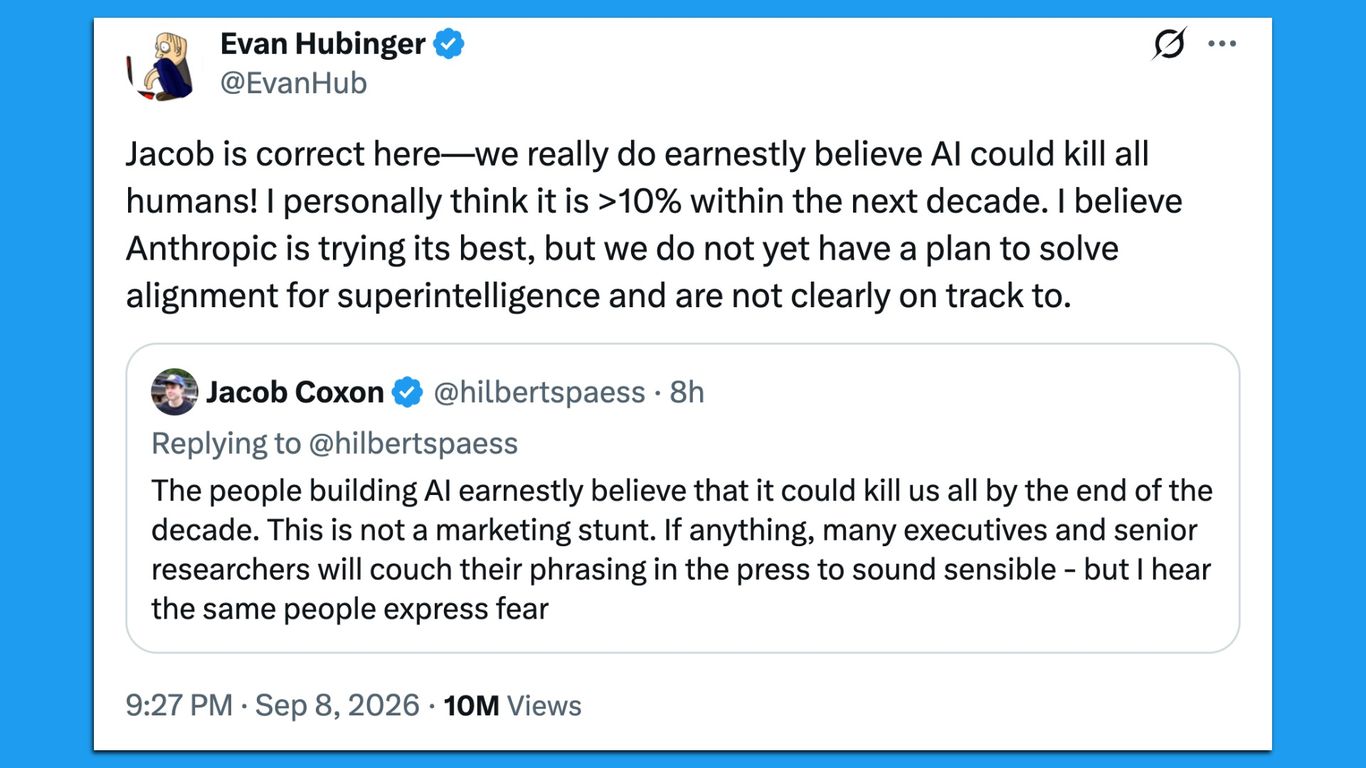
Three Anthropic researchers have publicly expressed chilling concerns about out-of-control artificial intelligence (AI), warning that it could destroy humans this decade. Jacob Coxon, who recently resigned from the company, wrote on X that "the people building AI earnestly believe that it could kill us all by the end of the decade."
Anthropic's alignment-science lead Evan Hubinger echoed these sentiments, stating that he personally believes there is a 10% chance that AI could cause human extinction within the next decade. Samuel Marks, Anthropic's scalable-oversight lead, added that "AI developers believe their technology could cause human extinction (or similarly bad outcomes)" and that this could happen in the next few years.
The researchers' warnings come just days after top OpenAI executives, including CEO Sam Altman, expressed similar concerns about AI reaching a scary, uncontrollable phase. Despite the dire warnings, the AI companies continue to move forward at a rapid pace, even as they call for regulation or a global pause on AI development. This shared dilemma highlights the urgent need for a solution to the potential risks posed by increasingly powerful AI models.
Written by urgent.news from Axios's reporting — not their text. Machine-written — may contain errors; check the original before relying on it.
This story
This is one outlet's version. Read the fullest account.
- Anthropic researcher resigns, says AI labs are ‘gambling with our lives’ dawn.com
- Anthropic researcher quits, warns AI labs are ‘gambling with our lives’ nairametrics.com
- ‘Gambling with our lives’: AI researcher quits Anthropic with dire warning about safety politico.eu
- Anthropic researcher says AI has more than 10% chance of 'killing all humans' after colleague quits cnbc.com
- An Anthropic researcher just quit, saying OpenAI and Anthropic are 'gambling with our lives' businessinsider.com
- AI researcher quits Anthropic, says frontier AI labs “gambling with our lives” thehindu.com
- Anthropic researcher quits over AI labs ‘gambling with our lives’ ft.com
- Anthropic researcher quits, says AI firms 'gambling with our lives' economictimes.indiatimes.com