A photon from the biggest cosmic explosion since the Big Bang appears to have defied Einstein. Scientists may finally know how
A photon from the biggest cosmic explosion since the Big Bang, the gamma-ray burst nicknamed "the BOAT," should not have reached Earth, according to Einstein. Now scientists may know how it did.
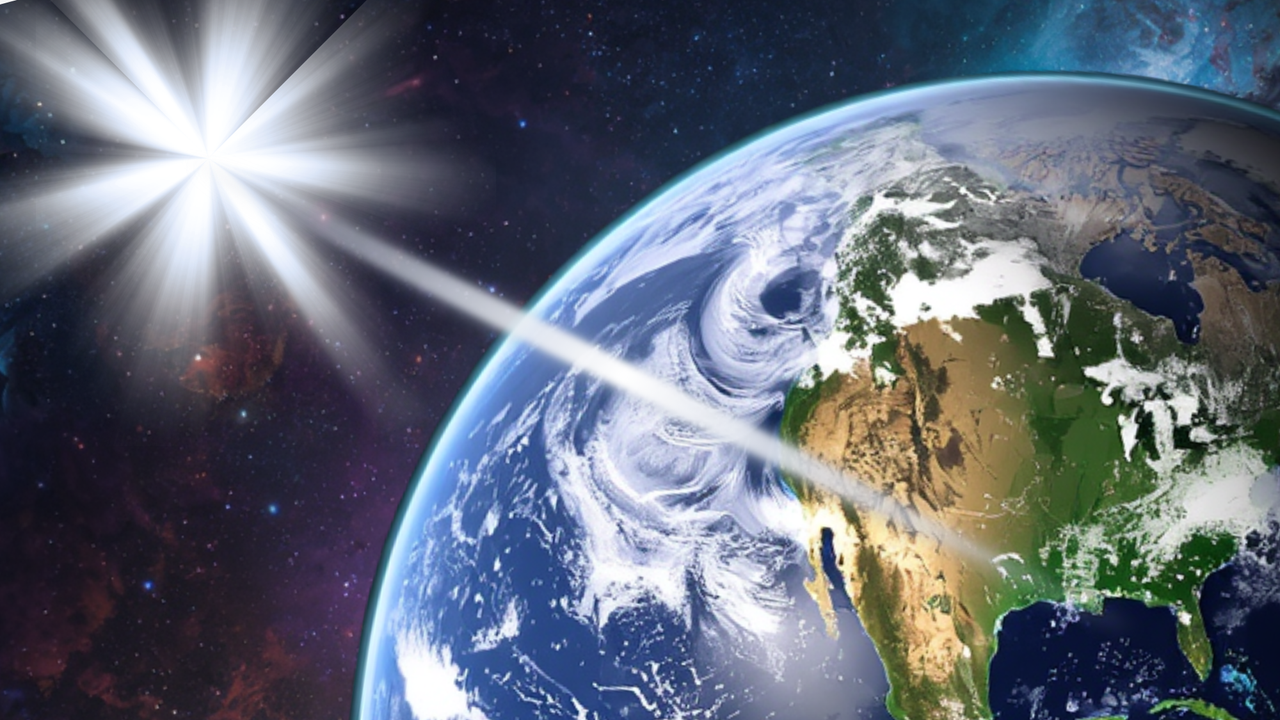
In October 2022, scientists detected the highest-energy photon ever observed from a gamma-ray burst, officially designated GRB 221009A, or the "BOAT" for Brightest of All Time. This cosmic explosion, occurring billions of light-years away, should have caused the photon to be absorbed by the cosmic microwave background (CMB) radiation, as per current physics laws.
However, the photon reached Earth, defying Einstein's rules. Researchers from the Italian National Institute for Astrophysics (INAF) and the National Institute for Nuclear Physics (INFN) explored this mystery by examining the possibility of axion-like particles (ALPs) transforming photons. Although ALPs alone couldn't account for the photon's high energy, researchers proposed that Lorentz invariance—a fundamental principle of special relativity—might be violated at such energies.
This would allow photons to avoid interaction with CMB photons, thus preserving their energy. The team's findings suggest that at high enough energies, photons could "take a fast lane" through the universe, bypassing the usual destructive transformations. Intriguingly, the BOAT's photon seemed to arrive at Earth a mere hour after lower-energy photons, supporting this theory.
If confirmed, these findings could open a new avenue for studying quantum gravity at unprecedented energy levels, using the universe as a natural laboratory.
Written by urgent.news from Space.com's reporting — not their text. Machine-written — may contain errors; check the original before relying on it.


