Researchers shrink double-slit experiment to atomic scale
Using a crystal as an atomic-scale interferometer enables direct visualization of local atomic arrangements The post Researchers shrink double-slit experiment to atomic scale appeared first on Physics World .
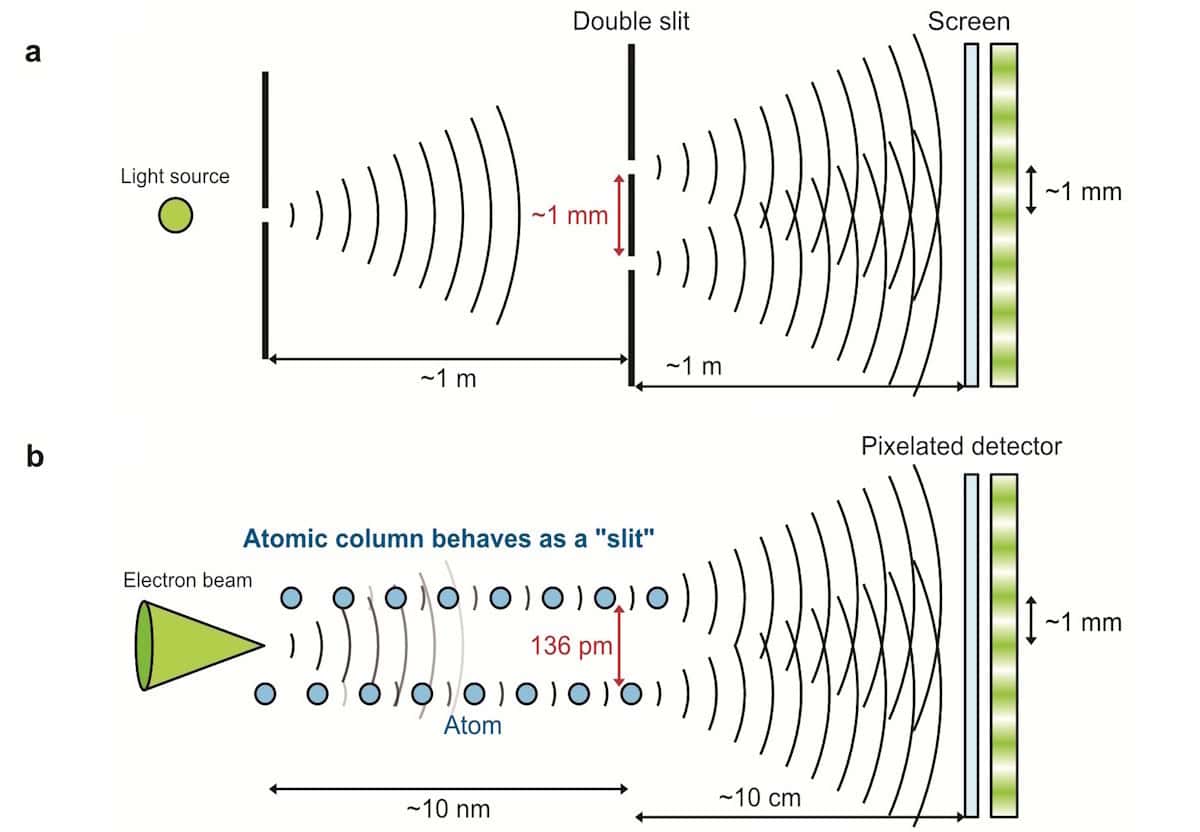
For the first time, physicists in Japan have conducted an atomic-scale version of the double-slit experiment. Utilizing an ultraprecise electron beam guided through two neighboring silicon atomic columns within a crystal lattice, researchers observed interference fringes in electrons scattered by the atoms. This achievement represents a significant reduction in scale from the original double-slit experiment, which was performed with light and involved a slit spacing of approximately 1 mm.
The Japanese team achieved a slit spacing of just 136 picometers (pm) through focused electron probes in a silicon crystal, creating electron interference fringes smaller than a thousandth of the original experiment's scale. These interference patterns encoded information about the crystal and electron beam, while also revealing the unique signatures of individual phonon modes in the atomic columns.
The researchers found that correlated vibrations between the two atomic columns helped preserve coherence and allowed for interference fringes to persist even at high temperatures, ranging from 300 to 900 Kelvin. This development not only offers new ways to measure phonon correlations directly between single pairs of atoms but also paves the way for probing local lattice dynamics at the level of individual atomic bonds, potentially influencing thermal transport in chip technologies.
Written by urgent.news from Physics World's reporting — not their text. Machine-written — may contain errors; check the original before relying on it.