OpenAI claims AI system solves 90-year-old Navier-Stokes problem
OpenAI says its internal AI has solved the Navier-Stokes existence and smoothness problem, one of the seven Millennium Prize Problems in mathematics.
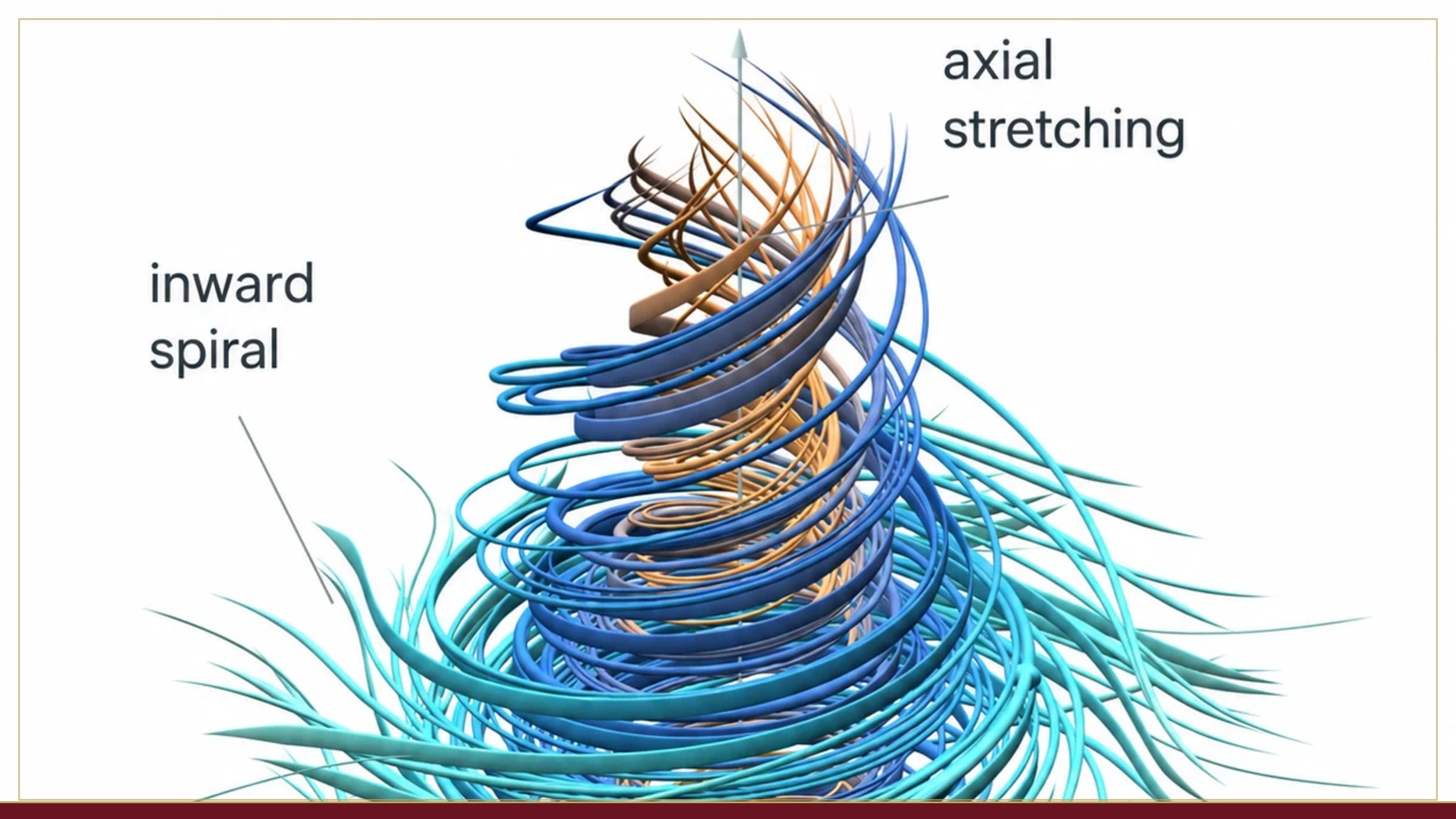
OpenAI claims its internal AI system has solved a 90-year-old mathematical problem known as the Navier-Stokes existence and smoothness problem. This problem is one of the seven Millennium Prize Problems in mathematics, and is considered one of the most difficult questions in the field. The company published a research paper detailing the solution, along with a formal proof verified using the Lean language for automated checking.
The Navier-Stokes equations describe the motion of fluids, and are used in a variety of scientific and engineering applications, including aircraft design, weather prediction, and blood flow studies. The central question posed by the problem is whether a smooth three-dimensional fluid flow can develop a singularity, or a point where the fluid's velocity becomes infinite in a finite amount of time.
OpenAI's AI produced a proof showing that such a singularity can exist, while still maintaining a finite amount of energy, under the influence of smooth external forces. This resolution covers cases C and D in the official formulation of the Clay Mathematics Institute's problem statement. According to OpenAI, the solution involves a vortex-like structure that twists and stretches inward, with its core shrinking and accelerating, all while keeping the energy finite.
The technical challenge was ensuring that this breakdown originates from the fluid's own motion, rather than from any externally imposed force. OpenAI began training a new internal model in August, which is described as significantly more capable than its public GPT-6 Astra model. The system underwent evaluation on all open mathematical problems, using a network of 10,000 cooperating agents.
This process took about 88 hours, with an additional 17 hours required for formalization and verification. Across all problems, the agents exchanged 4.9 million messages and generated over 300 billion output tokens, with the majority of activity focused on the Navier-Stokes problem. The company noted that the effort gained momentum after hearing about the work of Levent Alpoge, an employee at Anthropic, and Tristan Buckmaster, a mathematics professor at New York University.
These researchers had already resolved a forced version of the Euler equations, a simplified version of the Navier-Stokes problem. OpenAI acknowledged these prior efforts and stressed that their own research and AI agents had not been exposed to this work prior to their own discovery. OpenAI declined to claim the $1 million prize offered by the Clay Mathematics Institute for solving this problem, instead emphasizing the pace of progress in their AI models and cautioning against overemphasizing the achievement.
Written by urgent.news from Ajel English's reporting — not their text. Machine-written — may contain errors; check the original before relying on it.
This story
This is one outlet's version. Read the fullest account.