Op-Ed: The Lobito blind spot and Zambia’s manganese future
How Zambia’s focus on copper risks leaving a major critical-mineral opportunity stranded.
A common saying warns against "robbing Peter to pay Paul," meaning that solving one problem often leads to creating another. Zambia's approach to its critical mineral strategy appears to be falling victim to this dilemma. The Lobito Corridor is currently touted as a prime example of global energy transition projects, receiving strong support from the US, EU, and G7 partners.
This corridor promises to bypass existing bottlenecks, connect the Central African Copperbelt to Angola's Atlantic coast, and secure reliable copper and cobalt supply lines for Western markets. The plan is Washington's flagship infrastructure response to China's dominance via the Belt and Road Initiative. However, by concentrating this multi-billion-dollar transportation network almost entirely on copper, policymakers overlook a crucial element poised for explosive growth: manganese.
Often viewed merely as a steel ingredient, manganese is increasingly becoming a central component in advanced energy storage technologies. From lithium-manganese batteries to emerging supercapacitor-battery hybrids, the metal's importance is growing rapidly. China recently launched the world's largest 500 MW/1,000 MWh gigawatt-hour-scale supercapacitor-battery hybrid storage facility, signaling a potential future trend.
As these technologies expand, manganese will no longer be driven by traditional industries but will directly power the energy transition itself, and Zambia possesses significant manganese reserves. The question remains whether Zambia's infrastructure is prepared for this shift.
The Lobito Corridor was primarily designed to accommodate copper mining. However, Zambia's manganese is geologically different. Major manganese deposits are concentrated in the Luapula Province around Mansa, alongside other important sites in Central Province. These areas reside outside the favored transport corridor currently attracting international investment.
The result is a significant asymmetry that is easily missed in policy maps but critical in mining economics. Unlike copper, manganese's profitability hinges on the cost of transporting the ore rather than its quality. For copper, improved logistics offer a competitive edge, but for manganese, logistics often determine whether mining remains viable at all.
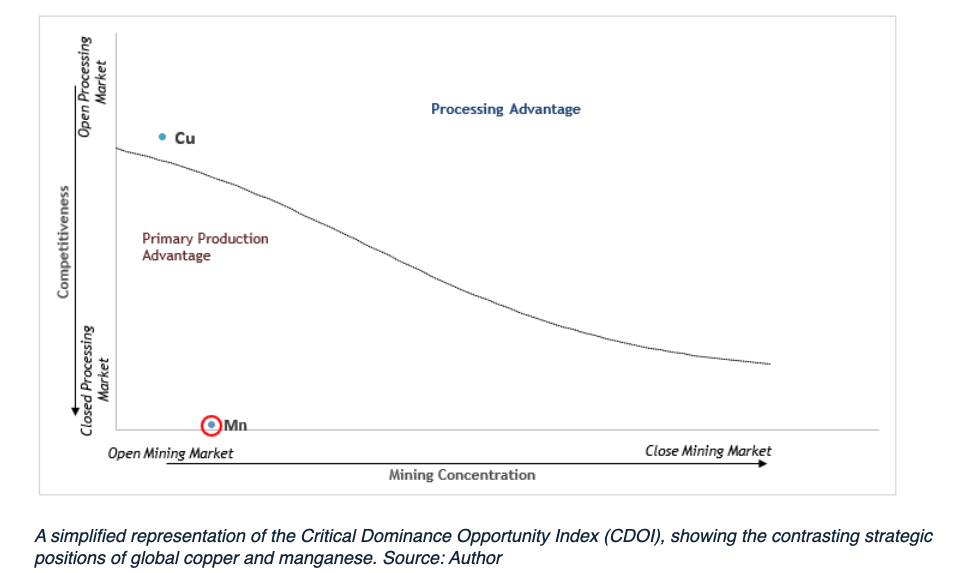
The Critical Dominance Opportunity Index (CDOI) provides a valuable perspective on this issue. The CDOI identifies where countries can realistically gain strategic advantage in critical mineral value chains. While copper benefits from highly contestable processing markets, manganese's market is already dominated by a few major players, making it challenging for new entrants.
Thus, mining remains the last major point in the value chain where Zambia can still build strategic advantage in manganese. This insight suggests that while Zambia is unlikely to become a global manganese refining hub, it has a tremendous opportunity to become one of the world's leading manganese producers before the next wave of battery demand reshapes global supply chains.
In conclusion, while maintaining the Lobito Corridor is vital, infrastructure planning should also focus on extraction corridors that align with Zambia's diverse geological wealth.
Written by urgent.news from Mining.com's reporting — not their text. Machine-written — may contain errors; check the original before relying on it.