More than 20 African countries fail WHO air pollution guideline in 2025 – AfriCAN 2026 Report
7 September marks the International Day of Clean Air for Blue Skies. It is a United Nations day reminding the world that the air we breathe matters. This year, the day comes with some sobering numbers. More than 20 African countries have yet to meet even the loosest air pollution guideline set by the World Health Organization (WHO). That is according to the first-ever continent-wide Africa Air…
The International Day of Clean Air for Blue Skies was marked on 7 September, highlighting a troubling reality for Africa's air quality. According to the Africa Clean Air Network (AfriCAN), more than 20 African countries failed to meet even the baseline air pollution guideline set by the World Health Organization (WHO) in 2025. AfriCAN, in collaboration with Copernicus Atmosphere Monitoring Service (CAMS) and the State of Global Air, released the first-ever continent-wide Africa Air Quality Brief.
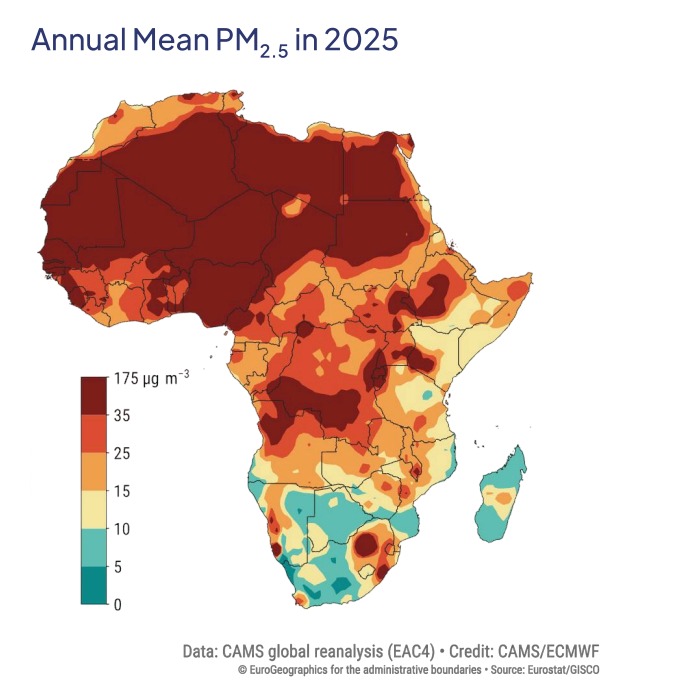
Dr Laurence Rouil, Director of CAMS, emphasized the importance of reliable air quality information for effective decision-making. The WHO measures exposure to PM2.5 particles using two tests: an annual average limit of 35 micrograms per cubic metre and a daily limit of 75 micrograms per cubic metre. In 2025, 30 of the assessed 50 African countries met the annual test, while more than 20 failed it.
The highest pollution levels were found in West Africa and the Sahel, particularly in Nigeria, Niger, and Senegal. The daily test revealed that Nigeria, Rwanda, and South Africa each had over 50 days exceeding the pollution threshold in 2025. While some pollution is caused by natural events like Saharan dust and biomass burning, human activities, especially cooking with charcoal and wood, vehicle exhaust, and waste burning, contribute significantly to the problem.
The situation has improved in some areas, with a decrease in high-pollution days in 25 countries and an increase in 17 since 2015. However, air pollution remains a multifaceted issue, affecting economies, development, climate, and environmental justice. Dr Caradee Wright of the South African Medical Research Council described air pollution as a "quiet, continuous, and regressive tax" on economies.
Bernice Swarts, South Africa's Deputy Minister of Forestry, Fisheries, and the Environment, emphasized that air pollution is now a public health emergency and a development challenge. Moortaza Jiwanji of the UNDP Africa Sustainable Finance Hub stressed the need to convince investors about the economic benefits of clean air. A separate UN Environment Programme (UNEP) and Climate and Clean Air Coalition (CCAC) report highlighted that every $1 invested in addressing climate change and air pollution yields around $15 in economic benefits.
This report estimated that outdoor air pollution caused 6.4 million premature deaths worldwide in 2025, with household air pollution responsible for an additional 2 million deaths, including around 300,000 children. The report also estimated that delaying action costs the world over $1.5 trillion annually in lost benefits. While some African countries are beginning to implement air quality monitoring programs, the challenge remains significant.
Written by urgent.news from MyJoyOnline Ghana's reporting — not their text. Machine-written — may contain errors; check the original before relying on it.