Japan's Hayabusa2 Achieves First-Ever Laser Ranging Experiment with an Asteroid
On Sunday July 5th, 2026, the Japan Aerospace Exploration Agency (JAXA) achieved the first-ever successful laser ranging experiment while making a flyby of an asteroid.
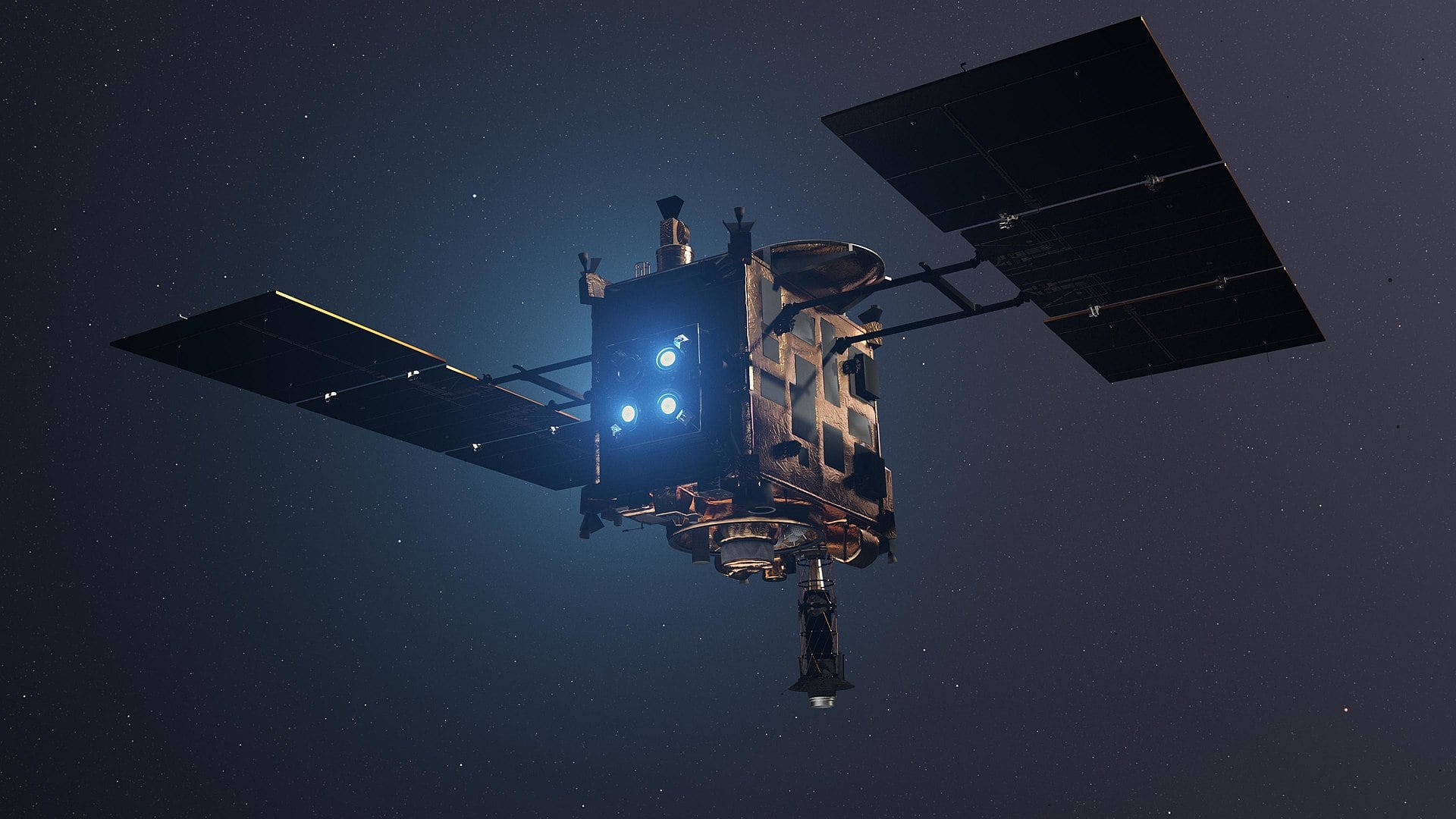
JAXA's Hayabusa2 spacecraft achieved a historic first with a laser ranging experiment on asteroid Torifune during a July 5th flyby. This marked the initial such experiment conducted by any space agency. The probe employed its LIDAR laser altimeter instrument, honed from the technology aboard the Kaguya lunar orbiter. The LALT instrument serves multiple purposes, including measuring distances, asteroid density, surface reflectance, and levitating dust particles.
It had previously contributed to surface topology data of asteroid Ryugu. Two laser pulses were emitted 4 and 3 seconds before the flyby, at distances of 20 km and 15 km (12.5 mi and 9.3 mi). The narrow laser beam, illuminating small surface areas of 30 and 23 meters (100 and 75.5 ft) respectively, posed significant challenges, necessitating precise spacecraft control and instrument calibration to avoid background noise.
Such laser ranging provides crucial scale to spacecraft images, enabling accurate size determination of astronomical objects. Combined with spacecraft tracking data, it can precisely pinpoint celestial body positions and trajectories, enhancing orbital predictions. This capability extends beyond space exploration, playing a vital role in planetary defense by accurately forecasting potential asteroid collision risks.
The successful experiment also demonstrates gathering vital information on celestial bodies while spacecraft move at high velocities. The team is now analyzing the data to pinpoint the exact laser-asteroid contact location.
Written by urgent.news from Universe Today's reporting — not their text. Machine-written — may contain errors; check the original before relying on it.