EU Enlargement Is Back as Brussels Fast-Tracks Accession
Accession talks accelerate in Brussels as Ukraine, Moldova, Albania, and Montenegro push for faster integration into the EU. The post EU Enlargement Is Back as Brussels Fast-Tracks Accession appeared first on Global Finance Magazine .
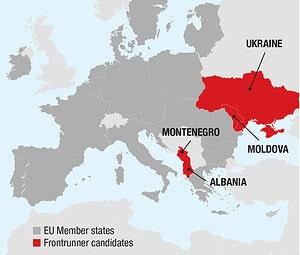
In a significant move for the European Union, it recently took a pivotal step towards enlargement on July 14, 2026, by conducting four separate accession conferences in a single day. The EU's Commissioner for Enlargement, Marta Kos, dubbed this event "Super Tuesday." This expansion follows the bloc's last major enlargement in 2004, when ten Central European states joined.
Since then, the EU has contracted when the U.K. left and when Croatia joined in 2013. Today, enlargement is seen not as a distant reward but as an active geopolitical strategy, influenced by Russia's invasion of Ukraine, China's growing influence, and uncertainty about U.S. commitment to Europe and NATO.
Unlike before, the EU now views membership as a mutually beneficial deal, focusing on border defense, energy security, and global leverage. Economic convergence, however, is outpacing political integration. The economies of Central and Eastern European countries have grown at more than twice the rate of the EU-15, the wealthier Western and Northern European nations.
Some of these newcomers have become the bloc's growth engine. In 2025, the Czech Republic, Latvia, and Lithuania posted growth rates of 2.6%, 2.1%, and 2.9%, respectively. Poland, the frontrunner, grew by 3.6% and ranked sixth in the EU by nominal gross domestic product, ahead of countries like Sweden, Ireland, and Austria.
Investors have also taken notice, with mergers and acquisitions in the region hitting a record €42.5 billion in 2025, a 36% increase from the previous year. Yet, enlargement comes with risks. Demographic decline, labor shortages, and exposure to geopolitical shocks could undermine the push toward enlargement. Politically, it could further hinder the decision-making process and strain the common budget under pressure from rising defense spending.
Regardless, expansion now seems inevitable. The eastern frontier region is no longer just a manufacturing base for the EU, but where the bloc's defense, industrial policy, and future growth will be decided.
Written by urgent.news from Global Finance's reporting — not their text. Machine-written — may contain errors; check the original before relying on it.