Did Venus eat its own moon?
Scientists may finally know why Venus, Earth's twin, lacks a moon, finding that the hottest planet in the solar system may have consumed its own natural satellite.
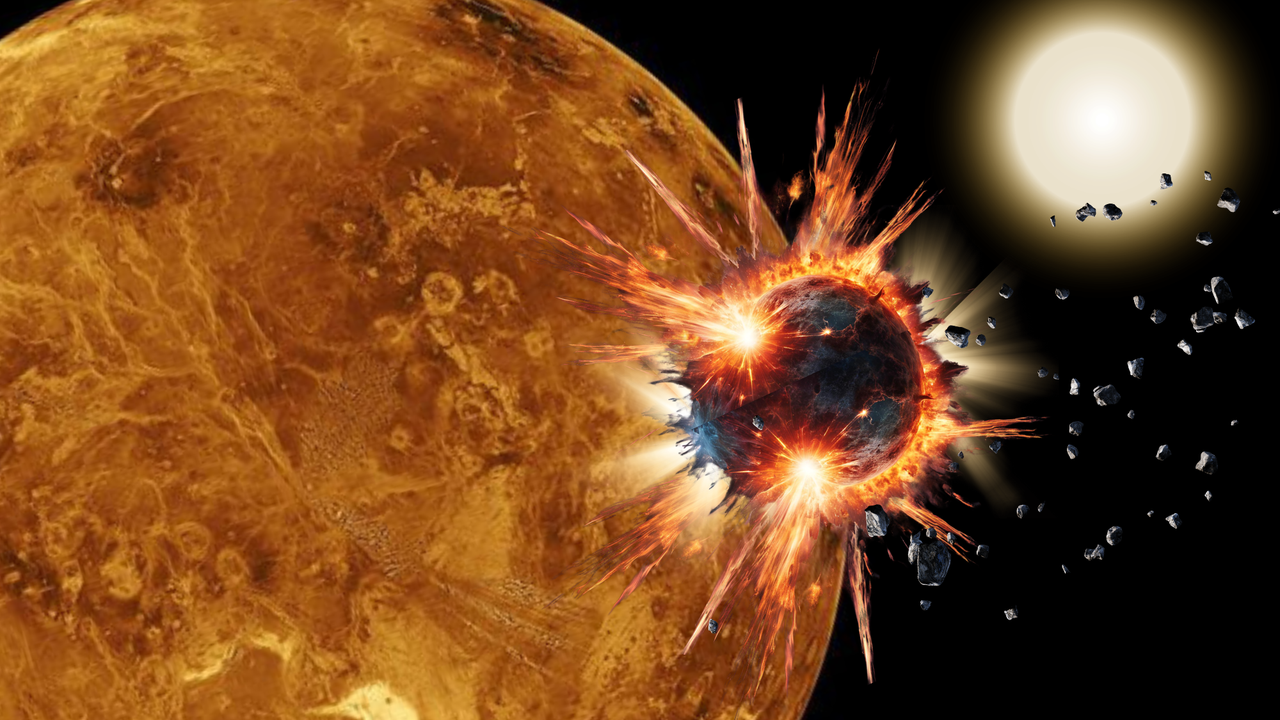
Scientists may have discovered why Venus, Earth's twin planet, does not boast a moon of its own. The leading theory is that Venus once had a moon, which was eventually consumed by the planet itself. Venus is often compared to Earth due to its size, mass, rocky composition, and proximity to the Sun, but there are significant differences between the two.
One major distinction is that Earth has a constant companion in the form of its moon, whereas Venus lacks any natural satellites. Researchers from the University of California, Riverside, led by Stephen R. Kane, have developed a simulation to test various scenarios of what could have happened to a hypothetical moon orbiting Venus.
The simulation involved fundamental physics, including the gravitational interactions between Venus, the moon, and the Sun, over billions of years. The study found that a Venusian moon would not slowly drift away as Earth's moon does but instead reverse its course and spiral inward, eventually being torn apart by Venus' gravity.
While a heavier moon would be destroyed faster, even a moderately massive moon would be at risk of being consumed by Venus. The researchers suggest that for a moon to survive, Venus would need to be spinning very fast during its formation, with a day shorter than approximately 12 hours, and the moon's mass would need to be no more than that of Earth's moon.
However, these conditions are not believed to have been present during Venus' early history. While direct evidence of Venus' past moon would be difficult to find, the researchers propose that future missions to Venus and observations of Venus-like exoplanets could provide indirect evidence. If such missions can measure the chemical composition of Venus' atmosphere or surface, they may be able to detect traces of a destroyed moon.
Written by urgent.news from Space.com's reporting — not their text. Machine-written — may contain errors; check the original before relying on it.