Beyond democracy: South Africa's unfinished economic story
As South Africa advances into the future, the pivotal question remains: how are we reimagining our economic landscape to empower the Black majority and ensure sustainable success for generations to come?
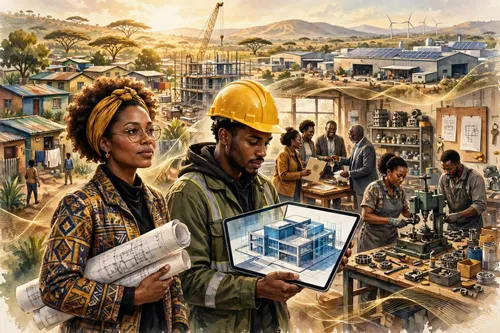
In South Africa, Black citizens have held political power for thirty-two years, yet their economic influence remains significantly behind where it should be. This discrepancy highlights the unfinished economic objectives that accompany political liberation. While democracy is crucial, it does not automatically translate into economic progress.
Economic power encompasses more than just employment; it includes ownership of assets, control of capital, creation of businesses, generation of intellectual property, establishment of institutions, influence over markets, and the purchasing power to shape economic outcomes.
Eskom, once the Electricity Supply Commission since 1923, serves as a case study for understanding the broader economic narrative. Originally designed to provide electricity to fuel South Africa's industrialization, Eskom's mandate has shifted over time. However, its primary purpose historically was to serve economic development, particularly in sectors like mining, railways, and industry.
The recent load-shedding crisis, which has disrupted construction projects and industrial output, underscores the critical role electricity plays in economic growth. Simply evaluating Eskom through conventional financial metrics fails to capture its foundational role in development.
Despite Black South Africans forming the vast majority of the population (81.4%), there is a pronounced economic disparity. The 2022 Census revealed substantial income and wealth inequalities across racial lines. This situation is not solely about consumption differences but also about ownership and productive capacity. For instance, a Black household purchasing goods from a multinational corporation contributes to the economy, whereas a Black-owned company that manufactures these goods, employs workers, owns intellectual property, and retains profits exerts genuine economic power.
These scenarios are distinct. Thus, South Africa must redefine transformation beyond employment figures or social welfare spending. The focus should shift to questions like who owns media platforms that shape public understanding of the economy, a crucial aspect given the SABC's current financial struggles and its limited control over the national narrative.
Additionally, the control over knowledge production is pivotal. South Africa's built environment, encompassing design standards, software systems, accreditation frameworks, and research infrastructure, continues to be largely shaped by external institutions, particularly those in the Global North. This dependency on foreign curricula, software, and intellectual products limits Black South African engineers, architects, and construction professionals' ability to assert their own economic and epistemic ownership.
The historical context further reveals that South Africa's economic structure was deeply entrenched in racial capitalism long before the rise of apartheid. Colonial conquest and the development of the mining economy laid the groundwork for the country's enduring economic inequalities. Consequently, South Africa must actively build institutions that can reclaim and shape its own economic and narrative destiny.
Only through this collective effort can Black South Africans fully realize their potential and steer the country's economic future.
Written by urgent.news from IOL's reporting — not their text. Machine-written — may contain errors; check the original before relying on it.
Also reported by 4 other outlets
- Ghana extends olive branch to South Africa despite strained ties over xenophobic attacks gbcghanaonline.com
- US Open Juniors: Ogunsakin eyes another milestone against South Africa’s Doig premiumtimesng.com
- South Africa’s congenital syphilis rate remains nearly four times above WHO target iol.co.za
- Here’s what contributed to South Africa’s economic decline citizen.co.za