Außenhandel: Dämpfer für deutschen Export - Probleme mit China
Nach fünf Monaten Wachstum verzeichnen Deutschlands Exporte im Juli erstmals wieder einen Rückgang. Schwierig bleiben die Geschäfte mit China, während ein anderer Markt überraschend deutlich anzieht.
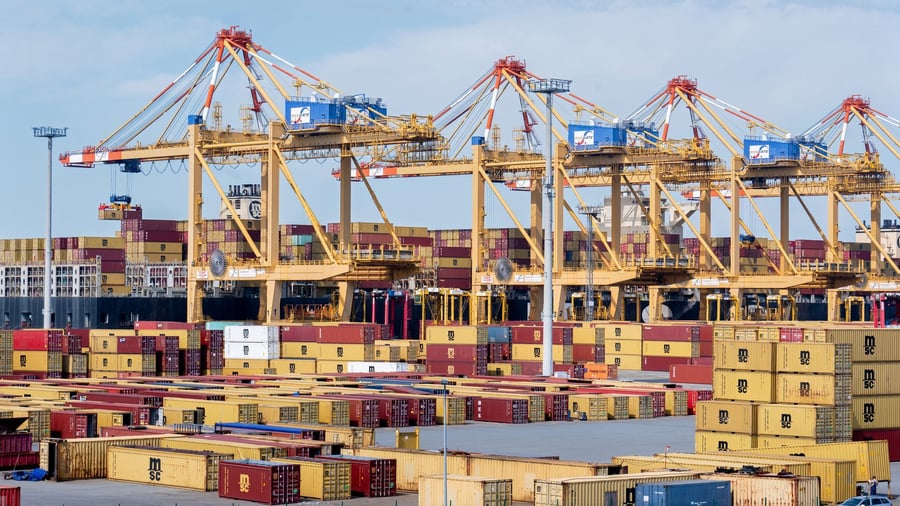
The German export sector has received a setback. According to the Federal Statistical Office, July exports declined by 0.8% compared to the previous month, despite a 6.1% increase year-over-year. Imports to Germany also fell by 5.7% compared to June. The exported goods totaled €138.2 billion, while the imported goods reached €116.9 billion.
The trade surplus widened to €21.3 billion, the highest since August 2024. The German Association of Large Trade, Foreign Trade, and Services (BGA) noted that the figures indicate the economic situation remains fragile. BGA President Dirk Jandura stated that a stable recovery cannot be expected. He called for "German foreign trade demonstrates resilience, but resilience alone is not enough.
Politics must implement fundamental reforms to strengthen the location and relieve businesses." The BGA also warned against interpreting the previous year's comparison positively, emphasizing the need to consider price effects. When export prices in July exceeded the previous year's level by 4.2%, a nominal export growth of 6.1% did not translate into a proportional increase in the quantity of exported goods.
German exporters mainly benefited from the US, with exports of €14.4 billion, a 19.1% increase compared to June and even 28.3% compared to the previous year. This was due to the implementation of the Turnberry trade agreement between the US and the European Union, which initially limits tariffs on most EU imports into the US to 15%, including cars and vehicle parts.
For European steel and aluminum, the duty is 50%. Conversely, the EU imposes no tariffs on US goods. The BGA also sees additional US demand for German machinery, equipment, and technology due to the reindustrialization of the US economy and ongoing investments in AI applications and data centers. Conversely, exports to China and the UK fell, while imports from China and the UK led to a decrease by 9.5% and 7.5% compared to June, respectively.
China imported goods worth €15.2 billion, also a 7.5% decline compared to the previous month. China has been expanding global exports, with August exports increasing by 25% compared to the same month last year, even more than in July (23.9%). Imports also grew significantly, reaching a 28.2% increase. However, Germany experienced a 9.7% decrease in exports.
In 2025, China achieved a record trade surplus of $1.2 trillion, primarily due to cars and electronic components to support the infrastructure for AI. The US and the European Union have long called for China to correct the imbalance in their respective trade relations. EU negotiations with China over solutions are ongoing, expected to conclude by October.
High-level talks between Chinese President Xi Jinping and US President Donald Trump were scheduled for September 24 at the White House. However, China has not confirmed the visit. The export offensive is partly a response to weak domestic consumption in China, posing a challenge for German companies as well. Oliver Oehms, CEO of the German Export Chamber (AHK) in North China, said, "What companies still need is strong domestic demand."
Written by urgent.news from Handelsblatt's reporting — not their text. Machine-written — may contain errors; check the original before relying on it.