Arm pushes agentic AI and desktop-quality graphics in next-gen phone platform
New CPU and GPU designs chase lower latency and richer games within a 1 W power budget
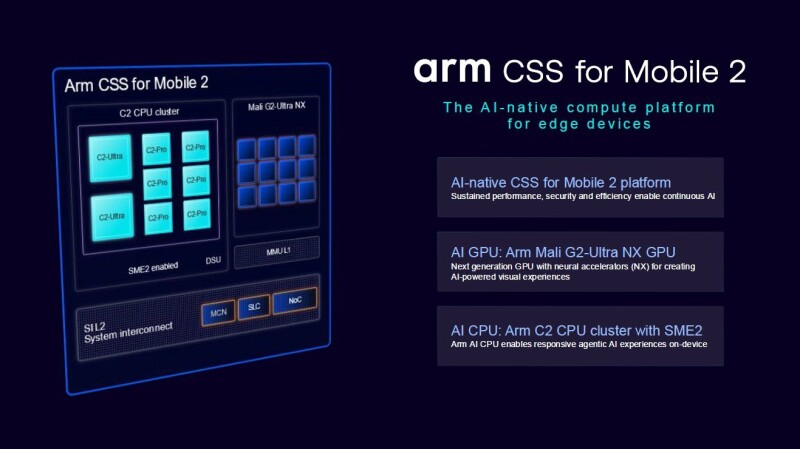
Arm's latest smartphone platform, Compute Subsystem for Mobile 2, is being introduced at the Arm Everywhere China event in Shanghai. This new platform is specifically designed to run AI agents on mobile devices and boasts neural graphics that claim to deliver desktop-class gaming within a smartphone's power limitations. The CSS for Mobile 2 represents Arm's growing emphasis on AI as a key strategy for future growth.
Chris Bergey, Arm's EVP of Edge AI, explains that AI workloads are increasingly moving from the cloud to devices at the network edge, due to the implications of latency, connectivity, and costs associated with maintaining these services on the cloud. He asserts that AI has evolved from background capabilities like speech recognition and image processing into tools that people actively engage with, including generative assistants that interpret objectives, coordinate applications and models, and execute sequences of actions.
The C2 CPU cluster in the new platform features a top-end C2-Ultra core that delivers up to 15 percent higher single-thread performance than last year's C1-Ultra. This core has a larger execution engine, improved branch prediction, and better fetch and target prediction to keep the instruction pipelines fed. The cluster can have two C2-Ultra cores, six efficiency-focused C2-Pro cores, and two SME2 units, compared to last year's platform which had one SME2 unit.
This doubling of SME2 capability reportedly enables up to a 70 percent speedup on the latest small language models.
The Mali G2-Ultra NX GPU, Arm's first AI-native Mali GPU, is also a highlight of the new platform. It introduces an all-new execution engine, neural accelerator hardware, and a third-generation ray tracing unit for full-scene lighting and shadows. The GPU supports Neural Super Sampling (NSS) and Neural Frame Rate Upscaling (NFRU), which together allow it to render desktop-class graphics within a 1 W power budget.
Arm claims a 30 percent boost in performance compared to previous iterations, even while rendering only one eighth of the pixels in the final sequence of displayed frames.
Written by urgent.news from The Register's reporting — not their text. Machine-written — may contain errors; check the original before relying on it.
This story
This is one outlet's version. Read the fullest account.