The math behind a Democratic wave — or a GOP upset
Data: The Downballot and Sabato's Crystal Ball at the University of Virginia Center for Politics. (Balance of power accounts for opposing party gains due to redistricting.) Map: Kavya Beheraj/Axios Redistricting has helped House Republicans build a seawall that can withstand a roughly 5-point Democratic wave. Why it matters: Early readings are pointing to something twice that size — enough to…
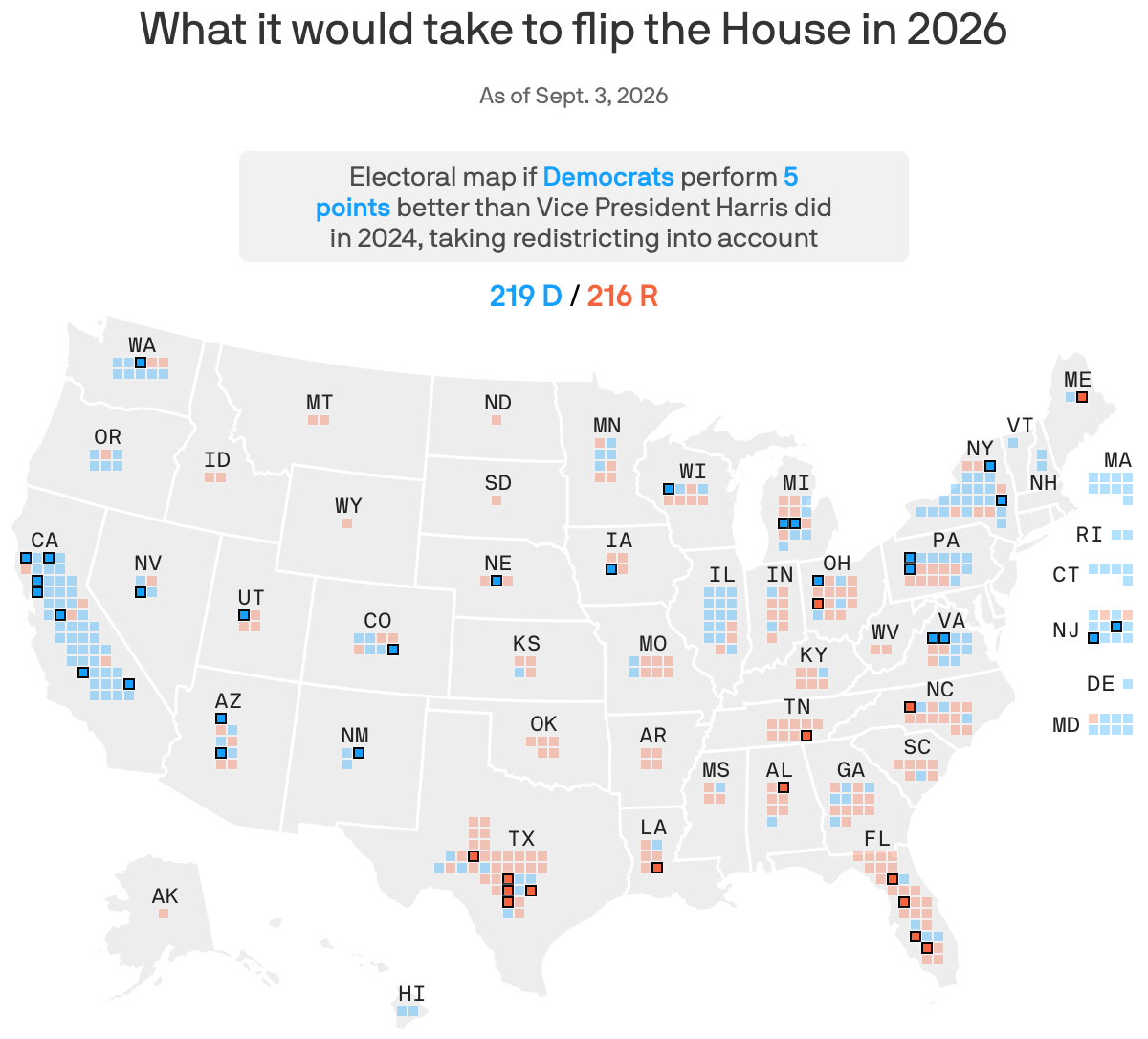
A recent analysis suggests the 2026 House election may result in a Democratic majority, with early readings pointing to a significant swing of 10 points in their favor. This would produce a comfortable 230-205 Democratic majority. However, Republican gerrymandering, which has given them a net advantage of roughly nine seats, could potentially save them from a sweeping loss.
Current polling indicates Democrats are up roughly 6 points over Republicans, which would translate to a 221-214 Democratic majority. In comparison, during the 2018 midterm election, Democrats gained 40 seats, producing a 235-199 majority when the national vote swung 6.5 points toward them from the 2016 presidential baseline.
If Republicans manage to outperform Trump's 2024 performance by 5 points across congressional districts, the new maps could give them a massive 253-182 majority. Conversely, if 2026 mirrors 2024, with GOP candidates performing as well as Trump, Republicans would net 16 seats, resulting in a 236-199 Democratic majority.
Two months before the election, Democrats seem optimistic, provided two conditions are met: President Trump remains unpopular and vulnerable Republicans closely align with him. Democrats privately believe that Republicans are encouraging vulnerable incumbents to attend the GOP midterm convention in Dallas and align themselves with Trump's campaign.
Republicans are banking on their significant financial advantage and a potential Supreme Court ruling that would allow them to coordinate campaign dollars with individual candidates. They also appreciate the fact that they have drawn eight Democratic incumbents into districts that Trump carried by double digits, a number that increased to nine after a Missouri Supreme Court ruling struck down a map that stranded Rep. Emanuel Cleaver (D-Mo.).
Despite Democrats outperforming Republicans on various metrics, money remains a crucial factor. If the raw numbers—such as the generic ballot, special elections, and primary participation—hold true, the advantages Republicans gained through redistricting may not withstand a substantial Democratic wave. However, waves are often clear only in hindsight.
Written by urgent.news from Axios's reporting — not their text. Machine-written — may contain errors; check the original before relying on it.