Palestinian parents fear for children's lives at school as settler attacks grow
A headteacher in the occupied West Bank has installed new barbed wire fencing after three pupils were killed this year.
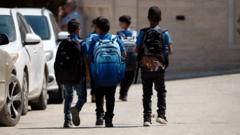
As the new school year began in al-Mughayyir, a village in the occupied West Bank, Palestinian parents grew increasingly concerned for their children's safety at school. The head-teacher, Bassam al-Assaf, expressed his fears, noting that six people, including three students, had been killed in al-Mughayyir this year due to a surge in settler violence. One of those victims was 14-year-old Aws al-Naasan, who was shot dead by a settler outside the school gates in April.
Waheed Abu Naem, an English teacher at the school whose brother was also killed in the same attack, recounted the terrifying moment he tried to protect his students from the settler's gunfire. Mobile phone footage captured the scene, showing the moment Aws was shot. Despite the tragedy, some parents were hesitant to send their children back to school, fearing further attacks.
The Israeli military claimed that stones were thrown at a car carrying civilians, and the settler who fired had been suspended and an investigation launched. However, the Israeli army's response to the growing violence in al-Mughayyir has been questioned. Ambulance crews are now stationed on the road outside the school to provide medical assistance, and several parents have volunteered to wait outside the school all day for added protection.
Parents and residents of al-Mughayyir are determined to keep their children in school, despite the fears and uncertainties surrounding them. The school sits on the edge of the village, surrounded by Jewish settler outposts and frequently blocked by Israeli forces. The situation has become increasingly dangerous, with settlers targeting children to pressure parents to leave their homes.
A UN Commission of Inquiry found that settler attacks have instrumentalized children, turning everyday spaces into sites of fear. Israel dismissed the report as a "libellous sham."
Written by urgent.news from BBC World's reporting — not their text. Machine-written — may contain errors; check the original before relying on it.