Managed Elections and Unmanageable Interest
Ksenia Smolyakova on a growing public appetite for debate about what is happening in Russia
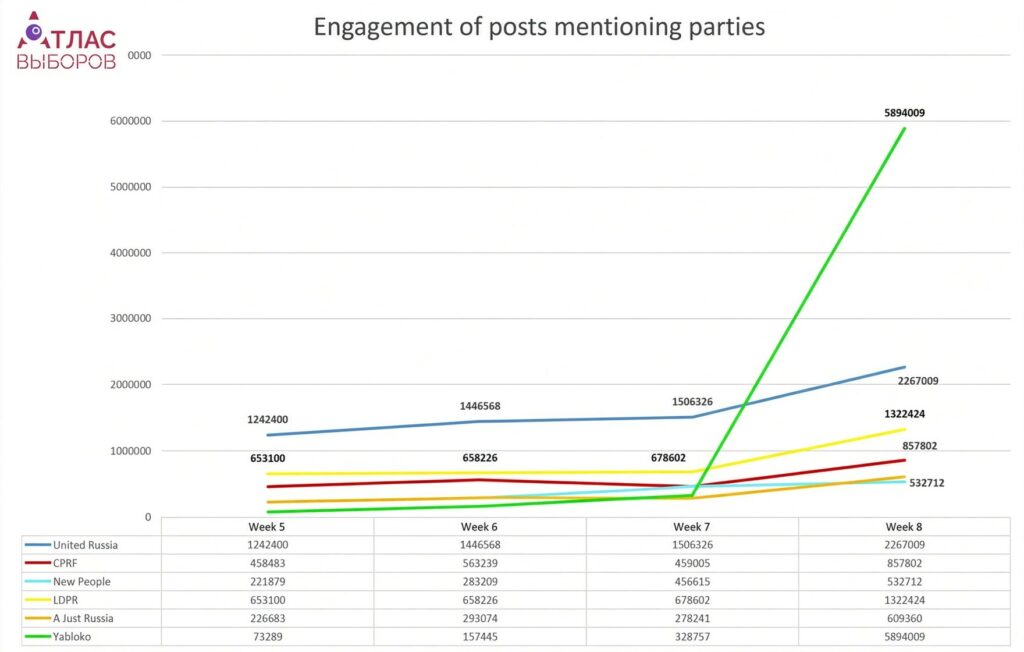
Immediately following the Supreme Court's decision to invalidate Yabloko's State Duma candidate list, it was noted that the party's original registration and subsequent surge in support had already disrupted the Kremlin's initial election predictions. During the two-week period following the registration, social-media observations from the Atlas of Elections project revealed that posts mentioning Yabloko garnered four and a half times more reactions compared to its previous levels.
Consequently, Yabloko moved into fourth place, surpassing A Just Russia and drawing close to CPRF and New People. New People, in turn, experienced a rapid increase in reactions as Russians compared them to Yabloko.
The nature of the analyzed sample was crucial. It consisted of posts from only four platforms: VKontakte, MAX messenger, Telegram, and YouTube. VKontakte and MAX messenger are state-controlled and under the direct supervision of Sergei Kiriyenko's son, who heads the presidential administration. Telegram and YouTube are blocked in Russia.
Other popular platforms among Russians, such as Instagram, X, and TikTok, were not included in the monitoring due to technical constraints. As a result, the sample exhibited a "statist" perspective on politics, which heightened the analytical value of the findings. The fact that the desire for open political discussion and active participation was evident even in this pro-government-leaning segment of the digital space suggested that such attitudes were prevalent in society.
Yabloko's registration, along with its subsequent cancellation, emerged as defining events in the campaign. Subsequent developments, including the filing of a lawsuit by Rodina to cancel Yabloko's federal list and the Supreme Court's approval of the claim, propelled the story to the top of Russian social media within a week. In terms of engagement—likes, comments, and shares—Yabloko emerged as the leading topic, experiencing an eighteenfold increase in reaction count in a single week and an eightyfold increase over a month.
Despite this surge in interest, television, which remains the primary news source for Russians, largely ignored Yabloko, mentioning it only briefly during the campaign. Television channels allocated minimal airtime to the party and failed to feature any of its representatives speaking on their own behalf. Conversely, all other parties in the race received extensive television and radio coverage, as well as space in prominent print publications.
The cancellation of Yabloko's participation in the election campaign could have allowed it to secure paid advertising, including during prime time, on television, thereby exposing its stance to the public for the first time during the campaign. This aspect was vital both in terms of the overall context and understanding why Yabloko's registration was revoked.
Following Yabloko's removal from the race, interest in the party began to wane two weeks after its elimination. Nevertheless, by the end of August, Yabloko still ranked among the top four parties in social-media metrics, despite a relatively low number of posts mentioning it. Russians' attention then began to shift towards other candidates and parties facing similar treatment.
In the second half of August, specific events, such as Vladimir Putin's speech at the United Russia congress, the CPRF losing a prominent regional candidate, Nikolai Bondarenko, and ongoing pressure on opponents from other parties, generated notable reactions online. Posts about United Russia, in response to Putin's speech, garnered 1.16 million reactions (likes, comments, and shares), while content about Bondarenko's removal received 1.48 million reactions—22 percent higher.
This difference, although based on reactions to posts, reasonably reflected real audience interest due to the scale of engagement observed.
Moreover, the total count of posts regarding the removal of other candidates and parties surpassed twice that of posts mentioning Vladimir Putin during the same period. More than a quarter of social-media users who read material about political parties in that week focused specifically on candidates being taken off the ballot. (The sample excluded posts mentioning Yabloko, as it had already been removed from the race.)
The intensity of discussions and debates during August—regarding party programs, statements by the head of state, and the authorities' efforts to further restrict competition—revealed that the public's primary interest lay in opposing the authorities' attempts to manipulate the already limited electoral competition. The original plan, as it appeared, was to conduct the election quietly, routinely, and predictably, despite the challenging circumstances.
Written by urgent.news from Riddle Russia's reporting — not their text. Machine-written — may contain errors; check the original before relying on it.
This story
This is one outlet's version. Read the fullest account.