Japan is launching a mission to bring back the first samples from a Martian moon
The "Martian Moons eXploration" mission, or MMX, is expected to take about a year to reach Mars. It will then spend three years operating around the planet and its moons before beginning a roughly one-year trip back to Earth. The sample return is expected in 2031. Read Entire Article
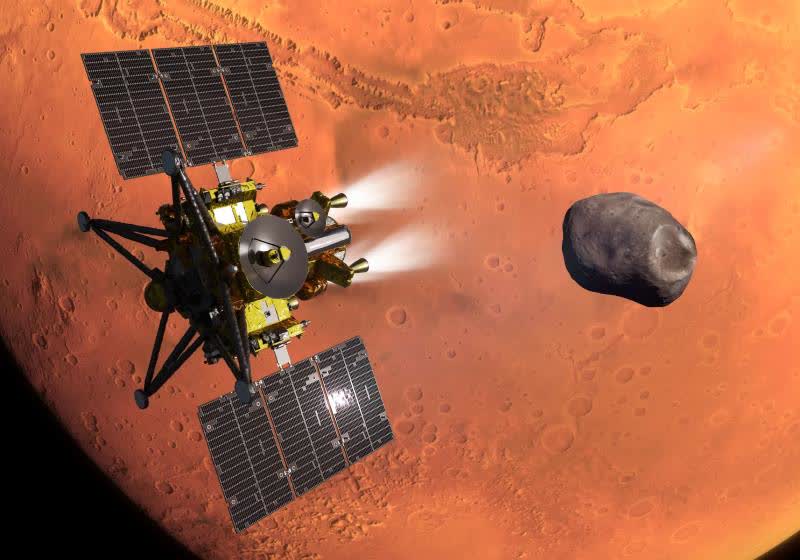
Japan plans to launch a spacecraft towards Phobos, a small Martian moon, in October 2026. The Japan Aerospace Exploration Agency's (JAXA) Martian Moons eXploration (MMX) mission aims to collect samples from Phobos and bring them back to Earth. If successful, the mission would return at least 10 grams of material, marking the first time a spacecraft has retrieved samples from a moon orbiting Mars.
The MMX mission is expected to take roughly a year to reach Mars, followed by three years of exploration around the planet and its moons. The return journey to Earth is anticipated by 2031.
Landing on Phobos poses significant challenges due to its small size and relatively strong gravity compared to other celestial bodies visited by JAXA. The spacecraft will rely on onboard decision-making during descent and landing, as communication delays with Earth could reach up to 20 minutes. Utilizing existing crater and terrain maps, MMX will identify safe landing sites and avoid potential hazards.
Upon arrival, the main spacecraft, weighing 4,480 kilograms, will launch from Tanegashima Space Center, carrying more than half of its mass as fuel.
The MMX mission includes a small rover named IDEFIX, developed by the French and German space agencies, which will explore Phobos for about 100 days. The rover aims to assess surface conditions before the main sampling process begins. MMX will employ a robotic arm to drill into the surface and collect samples in cylindrical tubes, as well as a nitrogen-gas sampling device originally developed by NASA to gather fine dust.
Scientists hope the samples will provide insights into the formation of Phobos and its counterpart, Deimos, which could be either debris from a Mars collision or captured asteroids from the outer solar system. The moons' relatively circular orbits, similar to Mars' equatorial plane, support the impact-debris theory. The sample return may reveal up to 0.1% of the material as originating from Mars, offering valuable information about the Red Planet's geological history.
The MMX mission is expected to cost approximately $345 million, making it Japan's first Mars probe launch in 28 years.
Written by urgent.news from TechSpot's reporting — not their text. Machine-written — may contain errors; check the original before relying on it.