Chartbook 473 Germany’s democratic earthquake: the AfD breakthrough in Sachsen-Anhalt and the question of an “alternative to the Alternative”.
Germany’s democracy has suffered an earthquake.
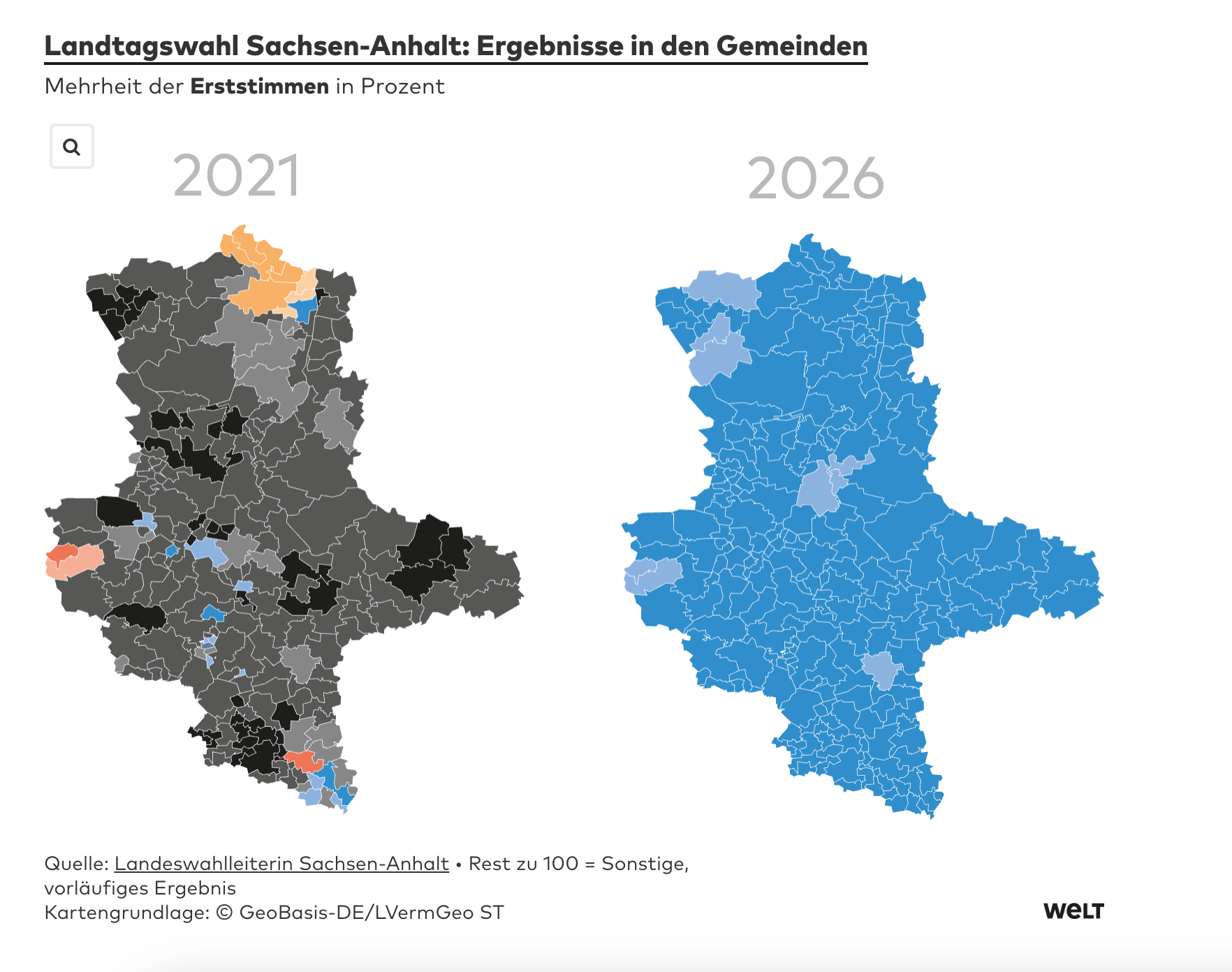
Germany's democratic landscape has witnessed a seismic shift in recent regional elections. The Alternative for Germany (AfD), a political party known for its right-wing extremist views, secured a substantial 44 percent plurality in the state of Sachsen-Anhalt, a region with a population of just over two million. This result marks a significant departure from the traditional political norms that have long defined the Federal Republic of Germany.
Despite the AfD's impressive performance, it remains unclear if the party will form the next government in Sachsen-Anhalt. Other parties may collaborate to prevent the AfD from gaining power. At the national level, the AfD faces even greater challenges in forming a government. Nonetheless, this outcome has sent shockwaves through Germany's political system, highlighting the erosion of established norms and the emergence of a new political reality.
The AfD's rise is not confined to Sachsen-Anhalt alone. Another small East German state, Mecklenburg-Vorpommern, is set to vote on September 20th, and the results may mirror the success of the AfD in its sister state. The AfD's ascent has long been anticipated by political analysts, who have long warned of the erosion of democratic norms in Germany.
One of the AfD's key figures, Ulrich Siegmund, is a charismatic and enigmatic candidate who embodies the party's unique blend of right-wing extremism and regional identity. A former corporate scent salesman, Siegmund's political ascent is as unconventional as his policy positions. He once proposed the idea of perfuming underground train stations with the scent of vanilla to reduce crime, a proposal that highlights the party's eccentric and far-right tendencies.
Born after the fall of the German Democratic Republic (GDR), Siegmund's background evokes memories of both the Stasi's oppressive regime and the nostalgic allure of East German culture. The Simson moped, a quirky symbol of East German identity, becomes a metaphor for Siegmund's appeal to the AfD's supporters.
The AfD's candidate has faced criticism and controversy, including his attendance at a secret meeting where members of the German right-wing discussed a program of mass "remigration." This policy position, once denied, has since been embraced by the AfD. Siegmund's dismissal of his detractors as unwelcome American busybodies has only served to fuel the controversy surrounding his candidacy.
The AfD's political narrative is rooted in a complex mix of nostalgia and radicalism. The party draws upon Germany's troubling history, including its first experience with a Nazi government in 1932. However, Sachsen-Anhalt also boasts a left-wing heritage, which adds another layer to the state's political landscape. In the late 1990s, the voters of Sachsen-Anhalt elected the Social Democratic Party (SPD) as the largest party, with the Party of Democratic Socialism (PDS), the precursor to Die Linke, coming in a strong third.
The SPD formed a minority government with the Greens, benefiting from the tacit endorsement of the PDS.
Written by urgent.news from Chartbook's reporting — not their text. Machine-written — may contain errors; check the original before relying on it.
Also reported by 1 other outlet
- The Alternative for Germany has won its best-ever election result hindustantimes.com