Brazil targets bigger role in critical minerals rush
Brazil is courting global mining capital while seeking greater control over strategic assets and more processing at home.
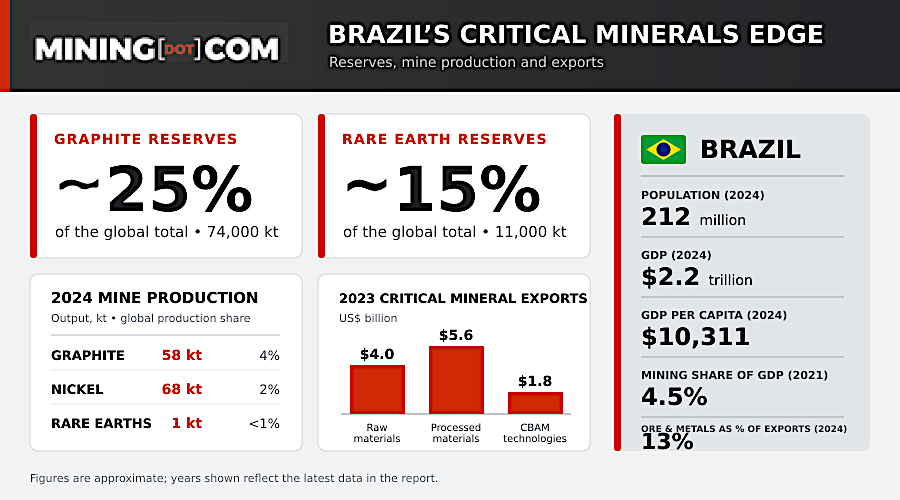
Brazil is aggressively seeking foreign investment to develop its abundant critical mineral resources while striving to retain control over processing and industrial stages. This push came into sharp focus when Brazil's Senate approved legislation establishing a National Policy for Critical and Strategic Minerals. The new legislation creates a presidential council tasked with overseeing corporate control of strategic mineral assets.
The mechanism could scrutinize foreign influence in such companies and international supply agreements that may impact Brazil's economic or geopolitical security. The bill also allows rules that tie exports to technical requirements or value-addition commitments and requires companies to disclose information about their destination, final beneficiary, and degree of processing.
The specifics of which transactions will be affected and how the screening will operate remain to be determined by future government regulations.
A recent example of the situation at hand is the $2.8 billion acquisition of Serra Verde, Brazil's largest rare earth producer, by USA Rare Earth (USAR). This deal is part of a plan to build an integrated mine-to-magnet supply chain away from China. However, the transaction has raised concerns in Brazil as Serra Verde's 15-year offtake agreement requires the export of its initial rare earth carbonate production, while Brasília seeks to develop local capacity to separate individual rare earth oxides.
As global partners seek secure supplies of critical minerals amid energy transition and supply chain realignment, Brazil is positioning itself as an attractive alternative to China. Western-listed companies are already involved in several of Brazil's most closely watched projects, such as Viridis Mining and Minerals' Colossus ionic-adsorption clay project in Minas Gerais and Meteoric Resources' Caldeira and Araxá projects.
These companies are positioning their projects not just as sources of rare earths, but as potential suppliers to Western industrial chains looking for China alternatives. Viridis' country manager in Brazil, Klaus Petersen, emphasized the urgency of reaching production in the coming years to transform Brazil's geological advantage into industrial and commercial advantage.
Written by urgent.news from Mining.com's reporting — not their text. Machine-written — may contain errors; check the original before relying on it.