Traditional, Vectorless, and Hybrid RAG: How to Choose the Right Architecture
Most teams default to Traditional RAG. Here is why Vectorless and Hybrid RAG are often the smarter production choices, with real-world examples for each.
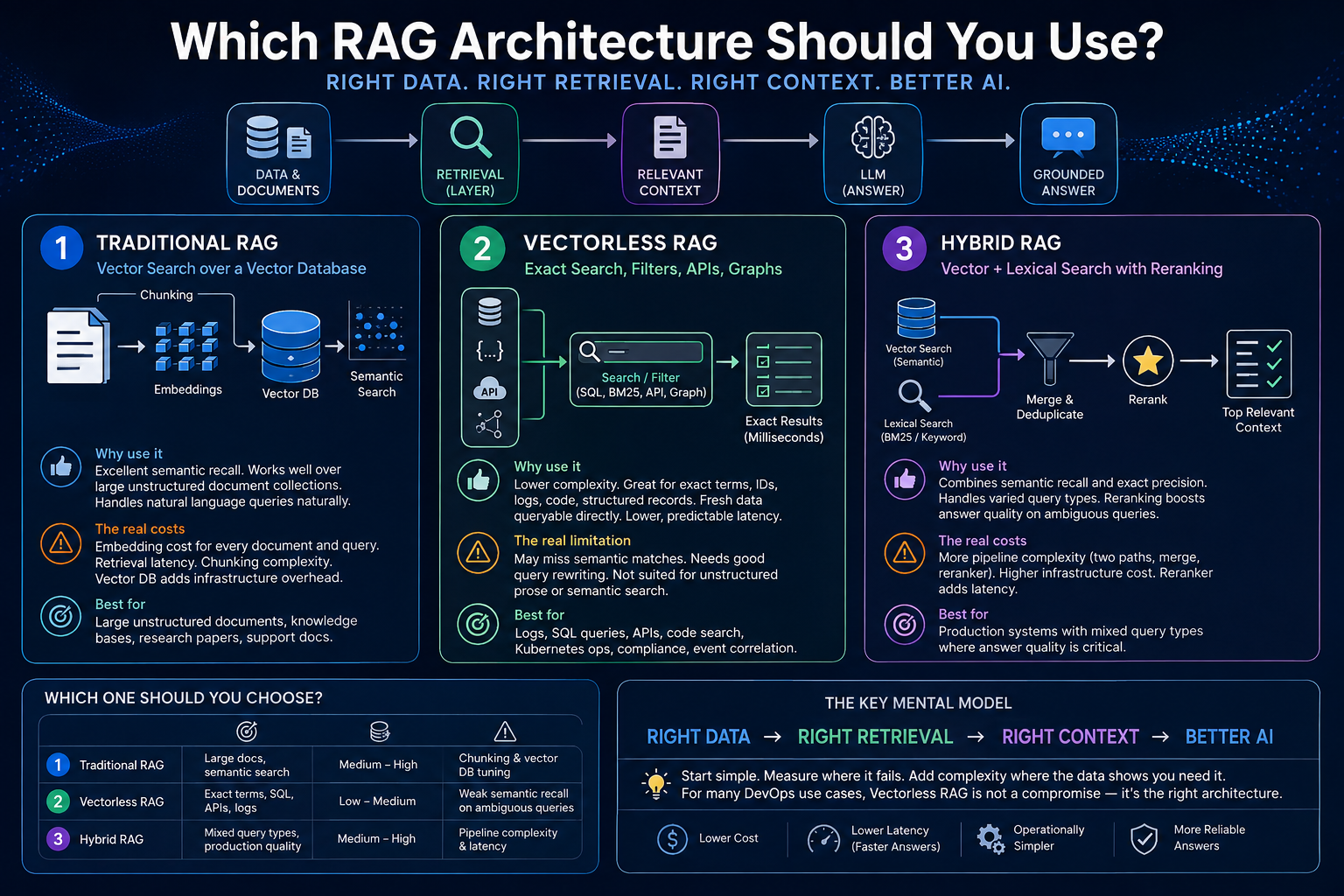
Traditional, vectorless, and hybrid Retrieval-Augmented Generation (RAG) architectures offer distinct approaches for building effective RAG systems, each with its own strengths and trade-offs. Traditional RAG relies on semantic similarity search over a vector database, yielding excellent semantic recall but at the cost of extra embedding, retrieval latency, chunking complexity, and vector store maintenance overhead.
This architecture shines for large collections of unstructured data where semantic understanding is paramount. Vectorless RAG, on the other hand, retrieves relevant content using exact search, database filters, APIs, or graph traversal. It offers lower infrastructure complexity, excellent performance for exact term lookups, and millisecond response times for structured records.
However, vectorless RAG may struggle with semantic matches when user queries deviate from indexed terms. Hybrid RAG combines the best of both worlds by merging vector search and lexical search before reranking the merged results. This architecture benefits from semantic meaning, exact keyword matches, and best evidence reranking, leading to improved answer quality.
Choosing the right RAG architecture depends on factors such as data type, query patterns, and production constraints. Traditional RAG excels for unstructured documents, vectorless RAG is ideal for structured data and exact lookups, while hybrid RAG offers a balanced solution for mixed data types and varied query styles.
Written by urgent.news from HackerNoon's reporting — not their text. Machine-written — may contain errors; check the original before relying on it.