A Pair of White Dwarfs Locked in a Six-Minute Orbit Might One Day Be Observed By Gravitational Waves
Future gravitational wave observatories will be able to see the gravitational waves of close-orbiting binary stars. A newly studied white dwarf system could be one of the first systems we observe.
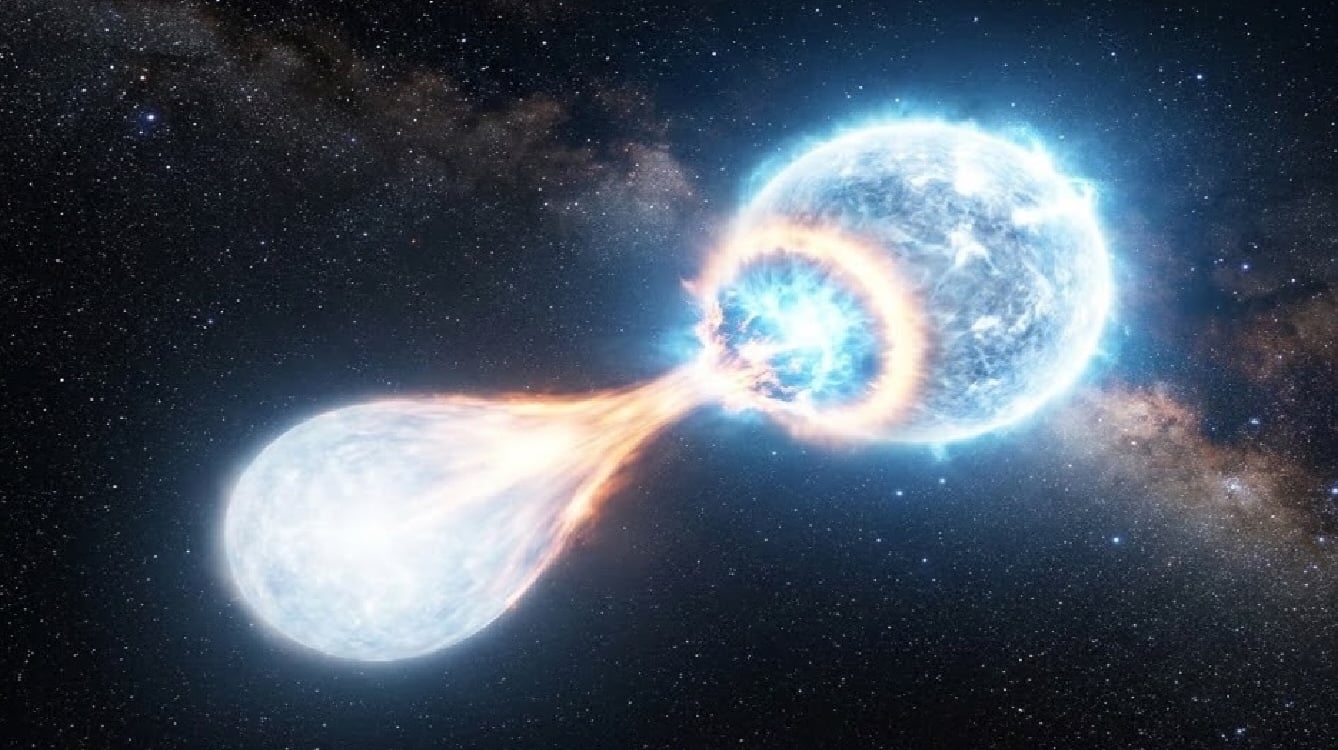
Advanced gravitational wave observatories are expected to eventually detect the gravitational waves produced by binary star systems. However, current instruments are not sensitive enough to observe these waves from binary stars. A recent discovery of a binary white dwarf system, known as eRASSU J0608, could be an excellent target for future gravitational wave observatories.
The system consists of two white dwarfs in a close orbit, with material from one star being directly captured by the other star, resulting in regular x-ray bursts rather than a constant glow. Observations using the Neutron star Interior Composition Explorer (NICER) and the Einstein Probe x-ray observatory revealed that the orbits of the stars in eRASSU J0608 are rapidly decaying, consistent with the loss of energy through gravitational waves.
This system is one of the fastest decaying binary systems observed, indicating it is a strong gravitational wave source. The estimated chirp mass of the system is 0.43 solar masses. However, the x-ray observations cannot determine the distance to eRASSU J0608, as gravitational wave signals weaken with distance. The team hopes to find a third stellar companion in the system, which would help determine the distance and enable detection of its gravitational waves by future space-based observatories like LISA. This could allow eRASSU J0608 to be used for calibrating gravitational signals of other objects.
Written by urgent.news from Universe Today's reporting — not their text. Machine-written — may contain errors; check the original before relying on it.