How Guangdong migrants set up world's largest electronics market in China
Merchants tracing their roots to a single region of eastern Guangdong Province account for an estimated 70% to 80% of the traders at Huaqiangbei, the world's largest electronics market in Shenzhen.
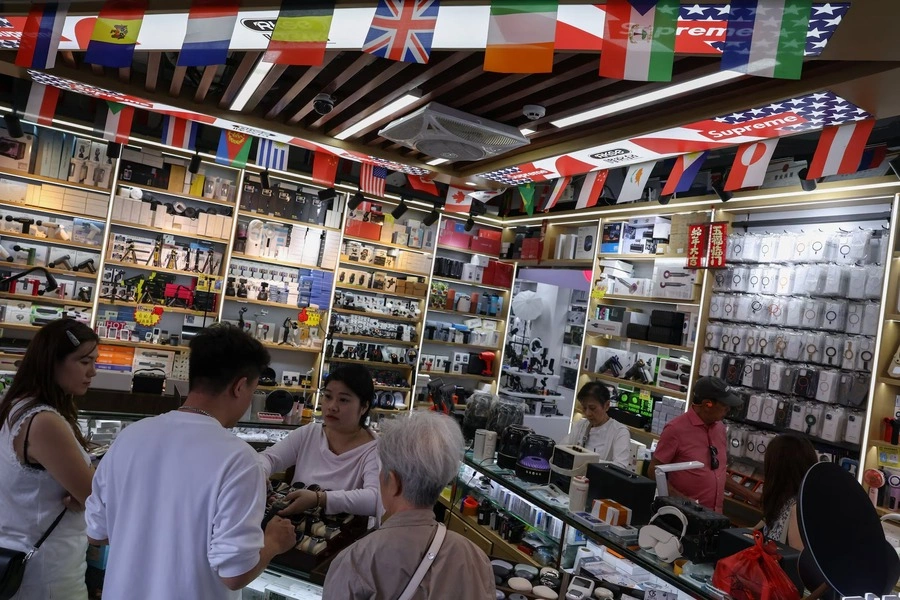
The world's largest electronics market is situated in Huaqiangbei, a 1.45 square kilometer area in Shenzhen's Futian District, according to the People's Daily. Huaqiangbei houses over 115,000 businesses and supplies more than 1 million types of electronic components and finished products, including smartphones, drones, robots, capacitors, and resistors. The traders at Huaqiangbei speak Teochew, a dialect originating from the Guangdong cities of Chaozhou, Shantou, and Jieyang, collectively known as the Chaoshan region.
Hong Kong tycoon Li Ka-shing, Tencent co-founder Ma Huateng, and Huang Guangyu, the founder of GOME, were all born in Chaoyang, Shantou. Huaqiangbei's origins date back to September 1979 when three military-industrial factories were relocated from Guangdong to Shenzhen and merged into Huaqiang Electronic Industry Company. The city's proximity to Hong Kong and the "three supplies and one compensation" model, which paired foreign equipment, materials, and components with local assembly, played a significant role in Huaqiangbei's development.
Initially, Huaqiangbei faced challenges such as e-commerce thinning crowds and traffic congestion. However, it gained attention as a showroom for artificial intelligence hardware due to China's visa-free entry rules and expanded tax refunds. Shenzhen, founded as a special economic zone in 1980, designated Huaqiangbei as a hub for electronics. Construction boomed, and Chaoshan migrants, drawn by familial arrangements, arrived and established their businesses in the area.
While imports required government approval and foreign currency quotas, Chaoshan traders used family networks to import advanced components through Hong Kong's free port and resell them to mainland factories. They also utilized a second supply line at Guiyu, a town in Shantou's Chaoyang, which became the world's largest electronic waste processing site. Authorities later redeveloped Guiyu into a circular economy industrial park, where incoming scrap is screened to prevent foreign e-waste from entering the facility.
Written by urgent.news from VnExpress International's reporting — not their text. Machine-written — may contain errors; check the original before relying on it.