Before You Automate a Decision, Define Its Blast Radius
Before automating a business decision, assess its blast radius across scope, detection, reversibility, and downstream dependencies to contain failures early.
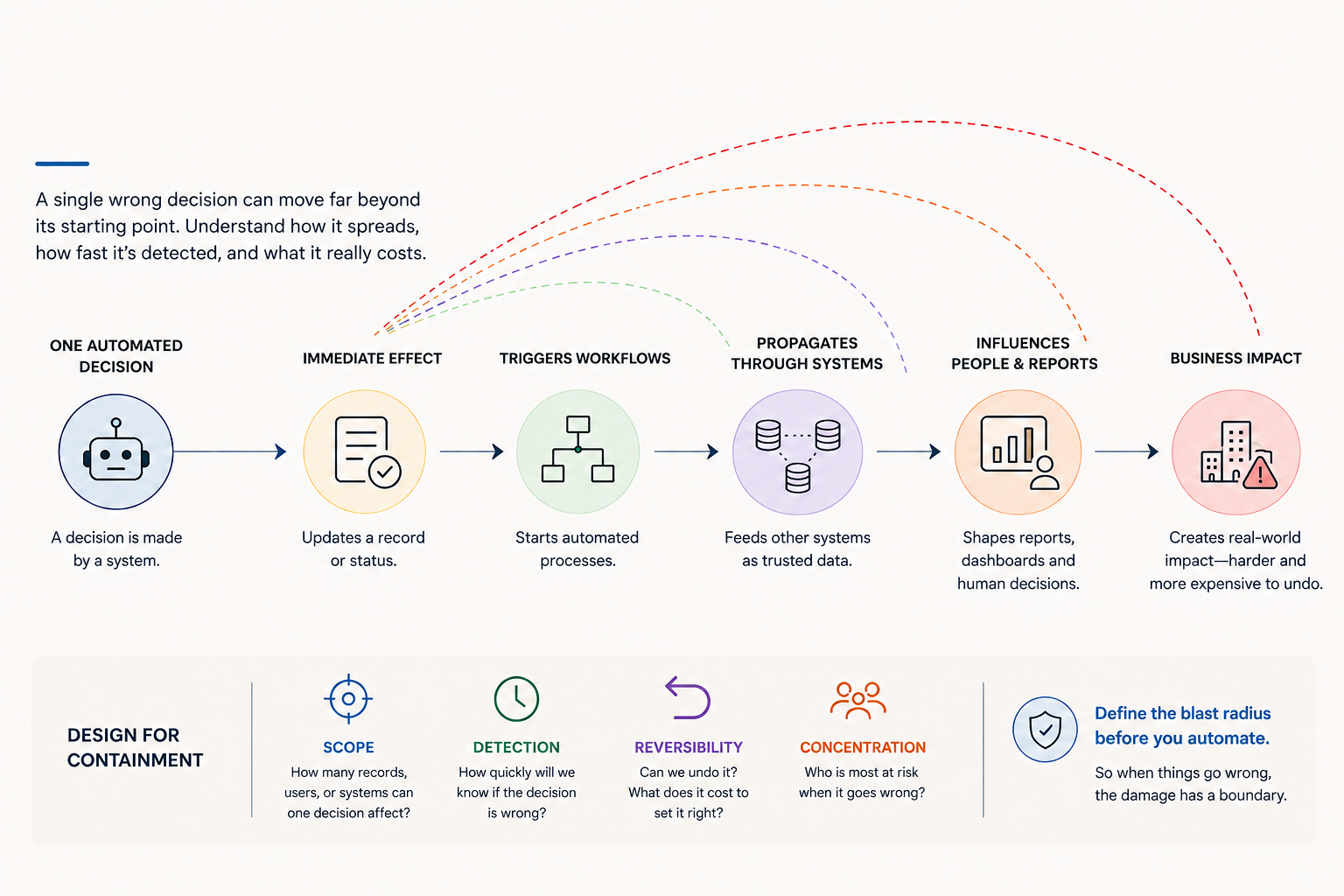
When evaluating the adoption of automated decision-making systems, it's crucial to consider their potential impact beyond mere accuracy. The term "blast radius" is often used in infrastructure and reliability engineering to describe the extent to which a failure in one service can affect other components. This concept is equally important for automated decisions. Before implementing such systems, organizations must understand their blast radius—the reach and consequences of a mistaken automated decision.
Accuracy, speed, and reliability are essential metrics for automated systems. However, they do not fully capture the potential fallout from a single erroneous output. Consider an enterprise workflow where support cases are automatically prioritized. Even a single incorrect ranking could delay responses, but the impact might be limited.
However, if this priority information influences other processes—such as routing, escalation, and reporting—the initial mistake can propagate, turning into data that multiple downstream systems rely on. This can have far-reaching consequences, making the accuracy metric insufficient in assessing the true risk.
Blast radius can be understood through four key dimensions: scope, detection, reversibility, and concentration. Scope refers to the breadth of influence a decision can have, including how many records, users, or systems it may touch. Detection deals with how long it takes to notice that a decision was wrong. If errors go unnoticed, they can become deeply embedded in processes. Reversibility considers the ease of correcting mistakes, while concentration assesses the degree to which a single decision affects multiple areas.
Recognizing the blast radius helps organizations anticipate and mitigate the broader implications of automated decisions, ensuring that the solutions they implement are not only accurate but also resilient and manageable in the face of potential errors.
Written by urgent.news from HackerNoon's reporting — not their text. Machine-written — may contain errors; check the original before relying on it.