The Hyderabad that was, and the city it is now
Once a city of leisurely chai, neighbourhood cinema halls, street-corner conversations and the twin cities, Hyderabad has changed almost beyond recognition. Over five decades, tech, infrastructure, migration and enterprise have transformed its physical and economic landscape. From the first stirrings of computing to AI, GCCs and towering business districts, the city has reinvented itself
Once upon a time, Hyderabad was a city of tranquility, familiarity and coffee. It was a place where people turned off their lights at home and young men gathered under streetlights to watch movies in cinema halls like Sangeet, Anand, Skyline, Lighthouse, Shanti, Amba and Manohar. The city was divided into two parts: 'androon' for the city and 'bairoon' for the suburbs.
People in Telangana towns such as Warangal, Nalgonda and Gadwal knew Hyderabad as 'Patnam', while Secunderabad was called 'Lashkar'. When G. Kasturi of The Hindu visited Hyderabad in 1975 to find an office location, it took him only four minutes to reach the Begumpet office. This was also the year when the Hyderabad Urban Development Authority (HUDA) introduced the Master Plan for the Municipal Corporation of Hyderabad area, covering 173 square kilometres.
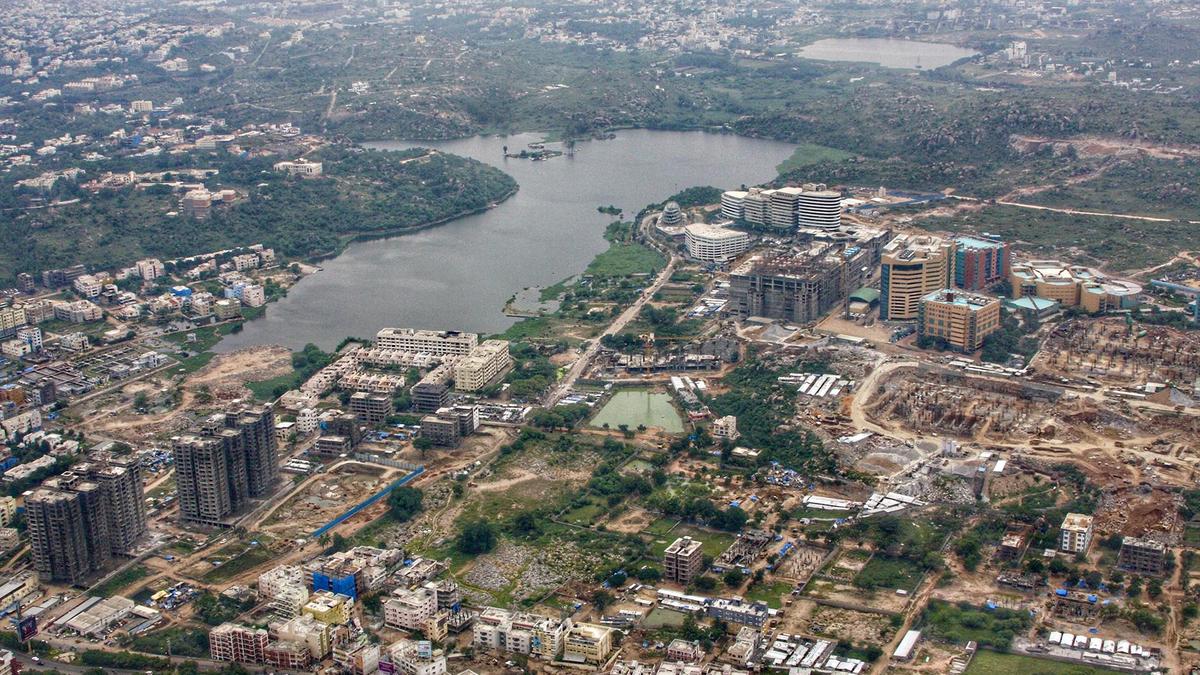
Today, Hyderabad has transformed into a city that changes every few months, appearing unrecognisable to its former residents. The only reminder of the old city is the phrase 'twin cities'. The IT revolution began in Hyderabad, right beyond the Musi River, at the Administrative Staff College of India (ASCI), where a marker commemorates its inception on September 1, 1976. The Computer and Library Building, inaugurated by the President of India Fakhruddin Ali Ahmed, served as a launchpad for the software industry.
The rise of Hyderabad's software boom can be traced back to the Electronics Corporation of India Limited, a spinoff of India's nuclear quest, and the exit of IBM Computers following the Janata Party government's tighter foreign exchange norms. The work on software translated into simple packages on financial accounting, vehicle scheduling and marksheet tabulations that were sold locally and eventually exported to Eastern Bloc countries like Bulgaria.
The isolationist Janata Party regime changed after Indira Gandhi returned to power. In 1982, the Union Cabinet approved the New Computer Policy, and in 1986, India began allowing the export of software using 'satellite data links'. The Software Technology Parks (STP) scheme came into being in June 1991, transforming Hyderabad into a software hub.
The Madhapur STP, now a kernel of the Hyderabad growth story, evolved into an ecosystem that draws talent from across the world and includes AI, visual effects and Global Capability Centre industries.
Written by urgent.news from The Hindu's reporting — not their text. Machine-written — may contain errors; check the original before relying on it.