Scientists detect signals of hydrogen from billions of years ago. Could this help us map out the universe?
Astronomers have used the MeerKAT radio telescope to detect hydrogen gas located billions of light-years away, from a period when the cosmos was billions of years younger.
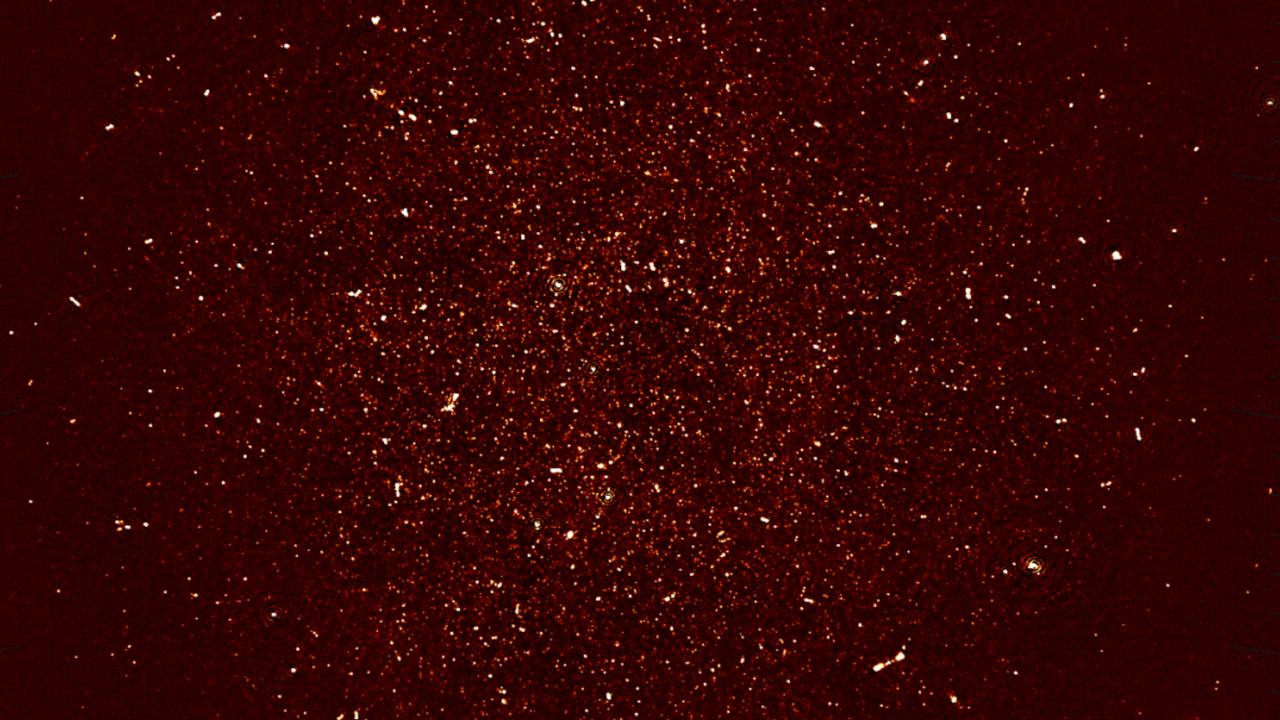
Astronomers have recently detected signals of hydrogen gas from billions of years ago using the MeerKAT radio telescope. This breakthrough could revolutionize our understanding of the universe's large-scale structure. The technique, called hydrogen intensity mapping, relies on tracing the faint 21-centimeter radio signal emitted by neutral hydrogen across the cosmos.
As the universe expands due to dark energy, the wavelength of this signal is stretched, allowing astronomers to determine how long the hydrogen has been traveling to us and what era it existed in. By mapping where hydrogen is located, researchers can create a 3D picture of the universe's largest structures.
Until now, hydrogen intensity mapping has been combined with visible light observations from galactic surveys. However, this new research demonstrates that the technique can be used solely with radio waves detected by MeerKAT, located in South Africa. Team leader Sourabh Paul expressed excitement about the milestone, noting that hydrogen intensity mapping is a promising way to map the universe efficiently. The challenge lies in isolating the faint signal from interference and instrumental effects.
The researchers analyzed 96 hours of MeerKAT observations, finding hydrogen signals dating back 4 to 5 billion years. This hydrogen spans millions of light-years, comparable to the distance between our Milky Way and the Andromeda galaxy. Neutral hydrogen plays a crucial role in understanding galaxy formation and evolution. With intensity mapping, researchers can measure the collective signal from hydrogen across vast cosmic volumes, providing a new way to study galaxy evolution and matter distribution.
Future cosmological surveys, such as the Square Kilometre Array Observatory (SKAO), could greatly benefit from hydrogen mapping advancements. MeerKAT's ability to extract the signal from observations not originally designed for hydrogen intensity mapping is encouraging, highlighting the telescope's scientific value and paving the way for future observations with SKAO.
The team will now focus on collecting further data that cover larger sky areas over longer periods, yielding even more detailed hydrogen maps that could help unravel the universe's largest structures' formation history.
Written by urgent.news from Space.com's reporting — not their text. Machine-written — may contain errors; check the original before relying on it.