Russian officials are calling the discovery of a medieval prince’s relics a miracle and plan to send a fragment to the front. But why do people venerate relics — and does Lenin’s body count?
Russia can talk of nothing but relics these days: in August, restoration work at the Archangel Cathedral in the Moscow Kremlin “found” a sarcophagus containing the well-preserved remains of Prince Dmitry Donskoy. The burial site of the commander of the Russian army at the Battle of Kulikovo had not been a secret, but after his canonization in 1988 the Russian Orthodox Church made no attempt to…
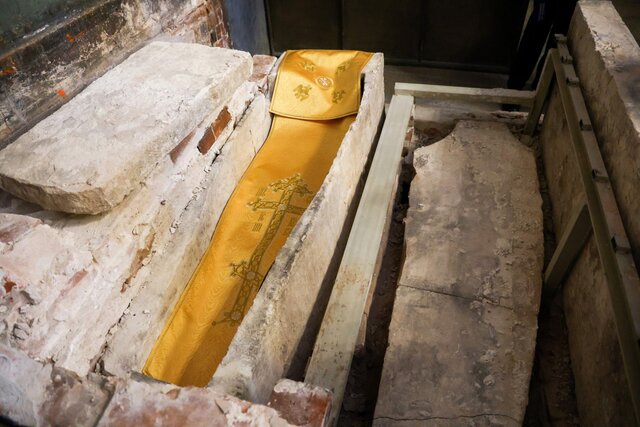
Russian officials have declared the discovery of the relics of medieval prince Dmitry Donskoy a miracle, with plans to send a fragment to the front lines. The Cathedral of the Archangel in Moscow recently unearthed a sarcophagus containing the well-preserved remains of the 14th-century commander, who was canonized in 1988. The decision to reveal the relics came as part of a renewed patriotic fervor during the ongoing war.
The discovery has been hailed as a "sign of Divine Providence" and has already received the attention of Russian President Vladimir Putin, who participated in the veneration ceremony. Another fragment of the relics will participate in a religious procession in Moscow on September 6.
Relics, or the physical remains of saints, have been a subject of veneration for centuries, with early Christians venerating the remains of martyrs as early as the second century AD. The practice grew out of the need to commemorate the dead and honor the martyrs who died for their faith. Over time, the belief developed that a saint's body could be moved or divided, allowing their patronage to reach a wider audience. This practice became commonplace in the early Middle Ages and has continued to the present day.
The veneration of relics is not universally accepted within Christianity, with some Protestant denominations viewing it as idolatry. While Catholics and Orthodox Christians generally accept the practice, they draw a distinction between worship (reserved for God alone) and veneration (extended to saints and angels). A prayer to a saint is typically a request for intercession before God.
However, the scientific community treats the concept of relics with skepticism, as there is often little evidence to support their claimed miraculous properties.
Science and religion operate on different planes when it comes to the validity of relics. While scientific research may raise questions about the authenticity of certain relics, religious traditions often prioritize centuries of established practice and belief over historical evidence. This can lead to discrepancies between what science can prove and what faith dictates.
Whether or not a corpse can be considered a relic is not solely determined by the manner of burial. While Christianity traditionally emphasizes burial as a means of honoring the deceased, the veneration of saints' remains is separate from the burial process. Relics are typically associated with individuals who have been recognized as saints, often after a process of canonization that involves examination of their life and deeds.
In Orthodox Christianity, a tradition of venerating a deceased person is required before their remains can be considered relics. In Catholicism, canonization is a formal process that must be completed before a person can be deemed a saint and their remains venerated.
It is important to note that not every Christian corpse counts as a relic. The transition from corpse to relic typically requires a period of veneration and recognition by the church as a saint. This process ensures that relics are associated with individuals who have demonstrated exceptional faith and virtues, setting them apart from ordinary individuals buried in the ground.
Written by urgent.news from Meduza (English)'s reporting — not their text. Machine-written — may contain errors; check the original before relying on it.