Maersk unfurls new sail power for container ship
Maersk is launching a wind-assisted propulsion pilot, marking a first for its fleet. The post Maersk unfurls new sail power for container ship appeared first on FreightWaves .
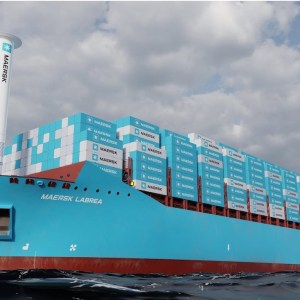
Maersk has entered into an agreement to install a novel "rotor sail" on one of its container ships, marking the company's inaugural venture into wind-assisted propulsion for its ocean fleet. The towering 115-foot sail, crafted by London-based Anemoi Marine Technologies, will be affixed to a colossal 984-foot, 8,700-TEU Lima-class vessel and will undergo operation during routine commercial service, with installation slated for mid-2027.
The ship is anticipated to navigate the north and south Atlantic routes while the sail is in operation. The system will undergo evaluation in commercial service thereafter. Typically, Anemoi affixes three to five rotor sails to a vessel, resulting in a daily fuel savings of one ton and a reduction of approximately three tons in CO₂ emissions, as per the company's specifications.
Maersk emphasizes that the rotor sail is part of a broader, fuel-neutral strategy to diminish greenhouse gas emissions across its ocean operations. The company's current focal points include scaling lower greenhouse gas-emission fuels like bio- and e-methanol, broadening its dual-fuel fleet, and enhancing network and vessel efficiency.
Earlier this year, CMA CGM initiated rotations of the sail-assisted Neoliner Origin, a roll-on/roll-off vessel anchored at the Port of Baltimore. In 2025, Maersk bolstered its fleet with ten dual-fuel methanol vessels and completed fuel-saving retrofits on 230 owned and 150 time-chartered ships, achieving a record low Ocean Energy Efficiency Operational Indicator (EEOI) of 10.8 gCO₂e per ton-nautical mile.
By 2027, Maersk projects 25 dual-fuel ships in service, with the aim of 25% of its fleet running on lower-emission fuels. The company has set a net-zero emissions target by 2040.
Written by urgent.news from FreightWaves's reporting — not their text. Machine-written — may contain errors; check the original before relying on it.